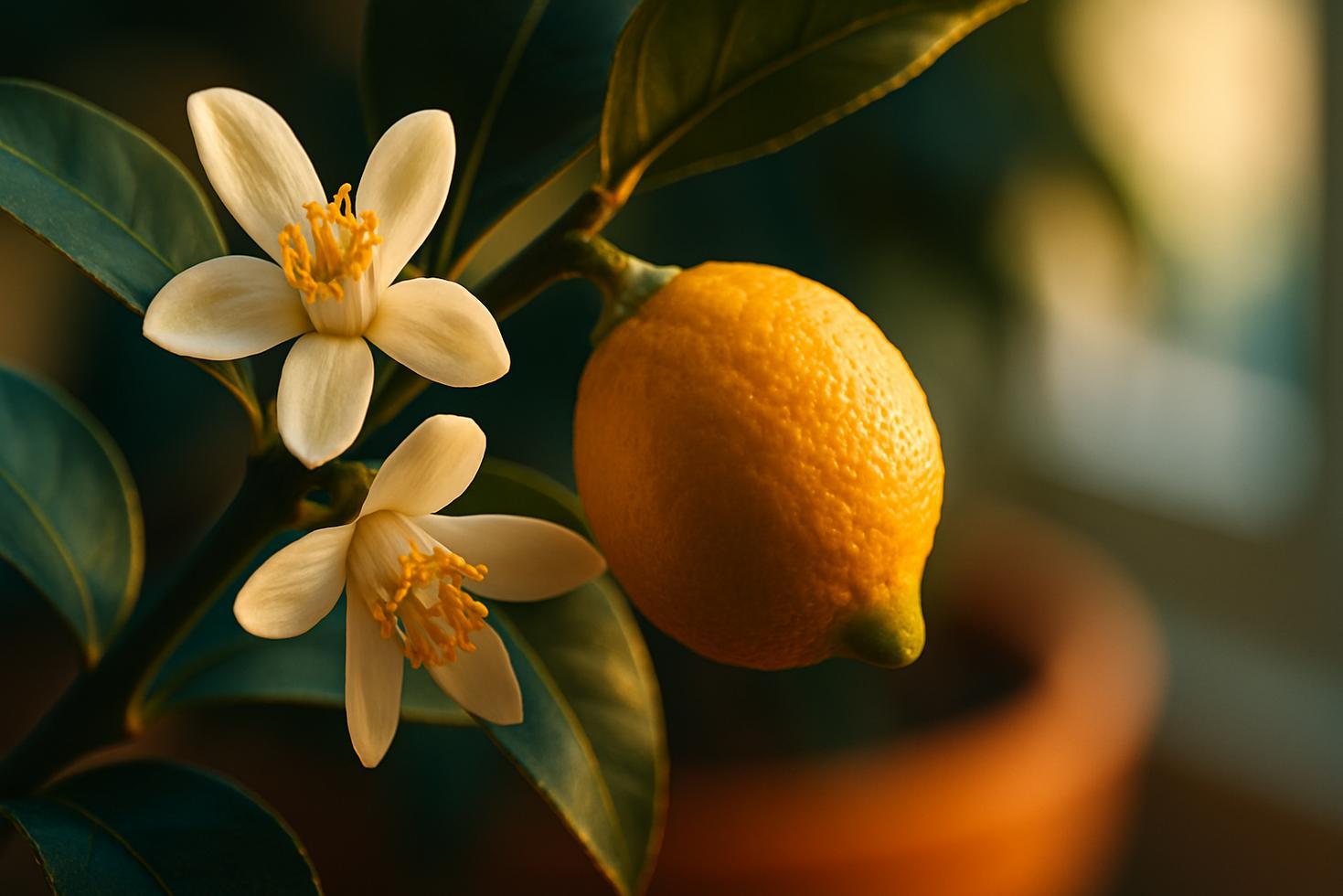
A Meyer lemon carries open flowers, swelling fruit, and brand-new buds simultaneously — unpollinated flowers abort in 7–10 days, and the tree sheds the weakest fruit the moment sugar, water, or light dips.
An indoor Meyer lemon dropping small fruit is not failing — it is running overlapping bloom cycles while continuously re-ranking which young fruit have enough carbohydrate, water, and light to survive. That process is normal, visible, and surprisingly systematic. The little fruit on the floor was not an accident.
Meyer lemons flower in flushes rather than one single event. That means open blossoms, recently fertilized ovaries, and pea-sized fruit can all occupy the same branch at once. The tree is balancing limited resources across three competing sinks — vegetative growth, flowers, and nascent fruit — and when any one resource runs short, something gets shed.
How the Indoor Resource Split Triggers Fruit Drop
The tree treats every developing fruit as a carbohydrate sink. When sugar supply, fluid pressure, or light falls below what all those sinks need, the weakest fruit get shed first. This is not random. It reflects which fruit received the least resources before the shortage hit.
Indoors, this cycle repeats because small stresses recur: a missed watering, a few cloudy days, a cool night. The tree resets each time. Partial set followed by drop, then another flower flush, is the signature pattern of an indoor Meyer lemon pushing against a resource limit it never quite clears.
What Indoor Conditions Actually Determine Whether Fruit Hold
Light is the primary driver. Meyer lemons need at least 8 hours of high-intensity direct light daily — around 1,500 foot-candles at leaf level. Without it, the tree cannot produce enough carbohydrate to sustain developing fruit alongside active vegetative growth.
Water stress ranks second. A dry root zone interrupts the fluid pressure that young fruit depend on for cell expansion. Root zone temperatures should stay between 60–75°F, and relative humidity at or above 40% during flowering helps flower retention.
Pollination is the third variable. Hand-pollination every 2–3 days per open flower is the indoor substitute for a single bee visit, which transfers pollen far more efficiently than still air allows. Brushing 3–5 flowers per session moves enough pollen to meaningfully improve set rates.
Frequently Asked Questions
Why does a Meyer lemon flower and fruit at the same time?
Citrus flowers in flushes rather than one event, so multiple cycles overlap. Open flowers, fertilized ovaries, and developing fruit coexist on the same branch during normal growth.
Is fruit drop always a problem on an indoor Meyer lemon?
Drop at pea size is normal and expected. Drop of every developing fruit signals a fixable shortage — usually light, water, pollination, or temperature.
How often should hand-pollination happen indoors?
Every 2–3 days while flowers are open, transferring pollen across 3–5 flowers per session, because each flower is only receptive for roughly 3–5 days.
What light level does an indoor Meyer lemon need to hold fruit?
At least 8 hours of direct light at roughly 1,500 foot-candles. Full-spectrum LEDs rated 40–60W, positioned 12–18 inches above the canopy, can substitute when natural light falls short.