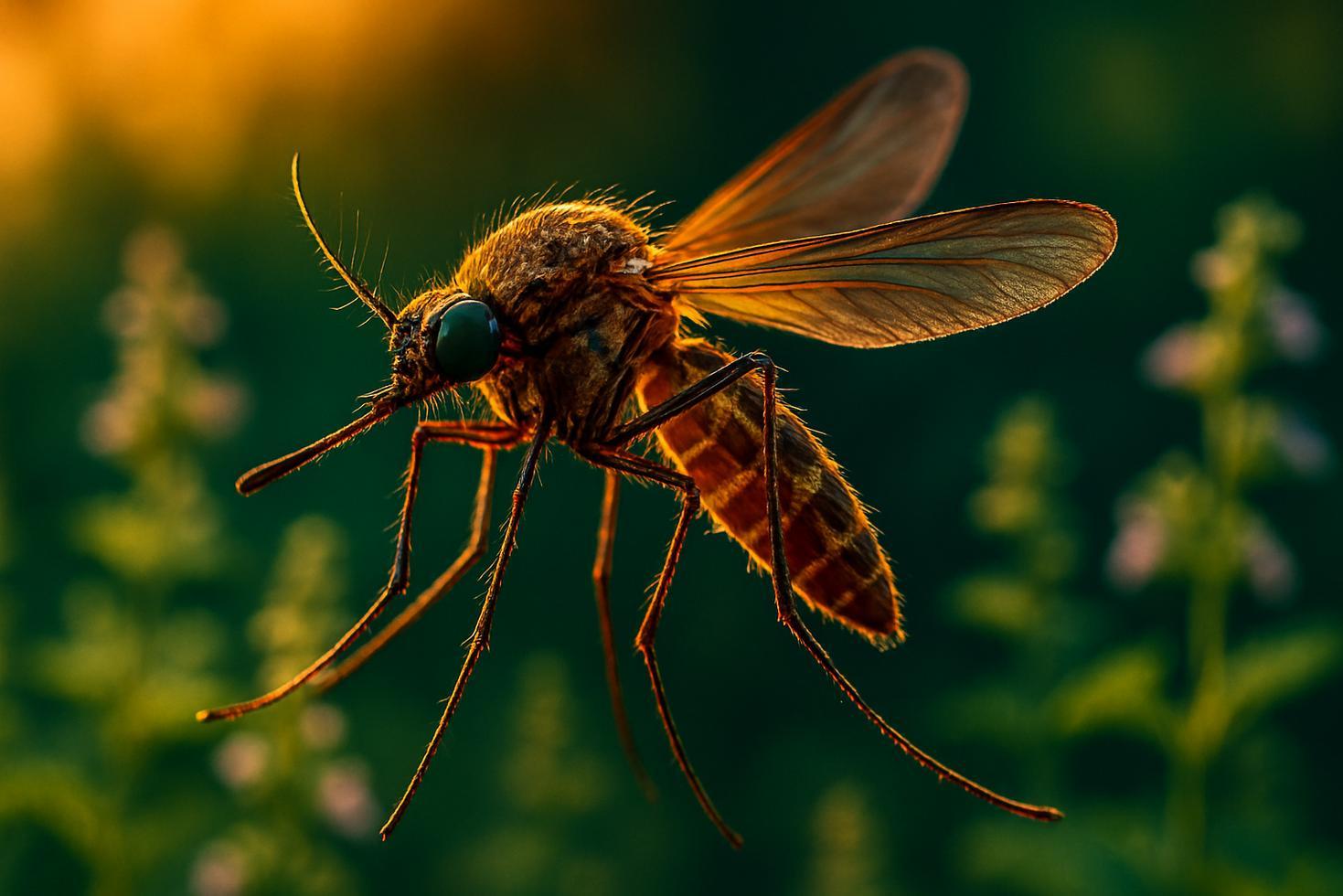
6% catnip oil matched 15% DEET in a 2024 Uganda field trial — and 2% oil alone blocked over 70% of mosquitoes for up to 4 hours.
Catnip essential oil, at a 6% concentration in lotion, matched the repellent performance of 15% DEET in a 2024 field trial conducted in rural eastern Uganda. That result came from a Cardiff University-led study published in Scientific Reports — not a lab tube, but real outdoor conditions with real mosquitoes. The active compound doing the work is nepetalactone, a volatile iridoid monoterpene that interferes with mosquito olfaction before the insect ever reaches a host.
Nepetalactone doesn’t sit on skin waiting for contact. It volatilizes into the air and disrupts the olfactory signals mosquitoes use to locate a target — carbon dioxide, body heat, sweat. Without that signal, the hunt stalls at a distance.
What the 2024 Uganda Field Trial Actually Found
The study tested catnip oil lotions at two concentrations — 2% and 6% — against a commercial lotion containing 15% DEET. At 6%, catnip oil repellence reached 79–89%, matching the 79–89% range recorded for 15% DEET in the same trial. At 2%, repellence still hit 68–79%. Catnip oil at 6% equaled DEET at more than three times the concentration — which means far less synthetic compound is needed to reach the same field result.
How Nepetalactone’s Spatial Repellency Differs from DEET’s Contact Action
A 2005 comparison study separated spatial repellency from contact repellency across three mosquito species. Catnip oil was the stronger spatial repellent — it reduced attraction in olfactometer-type tests more effectively than DEET. Nepetalactone masks olfactory host-seeking signals at a distance, interfering with approach before any landing attempt.
DEET, by contrast, performed better as a topical contact repellent. Against Aedes aegypti at 15 minutes post-treatment, DEET needed roughly 0.5 mg/cm² for effective protection; catnip oil required approximately 1.0 mg/cm² to achieve the same result. Against Anopheles albimanus, the dosage gap was wider still — DEET effective at 0.063 mg/cm², catnip oil requiring 0.75 mg/cm².
The two compounds work through overlapping but distinct routes. Neither “jams” flight mechanics. Both interfere with the mosquito’s odor-processing system, but nepetalactone’s advantage is spatial; DEET’s advantage is surface persistence.
The “10 Times Stronger” Claim and What the Evidence Actually Shows
A 2001 Iowa State University lab study reported that nepetalactone was roughly ten times more effective than DEET in a specific tube bioassay — 1% nepetalactone left about 20% of mosquitoes on the treated side versus 40–45% for DEET at equivalent doses. That result was real, but it was conditional on that assay format, those concentrations, and spatial exposure mode.
Later field and feeding-deterrent studies don’t support a blanket tenfold advantage. In feeding-deterrent bioassays, nepetalactone isomers were significantly less effective than DEET against Ae. aegypti on human volunteers. The 2024 Uganda data landed on equivalence at 6%, not superiority.
—
Pat has watched plant chemistry surprise researchers for decades. Catnip holding its own against a synthetic compound engineered for the job is exactly that kind of surprise — one worth watching as formulation science catches up.
Frequently Asked Questions
How long does catnip oil repel mosquitoes?
The 2024 Uganda field study found that 2% catnip oil lotion provided significant repellence for up to 4 hours after application.
Is catnip oil stronger than DEET?
Not generally. A 2001 lab bioassay showed tenfold superiority under specific conditions, but field trials show 6% catnip oil equals — not exceeds — 15% DEET.
Does catnip repel mosquitoes on contact or at a distance?
Primarily at a distance. Nepetalactone is a volatile spatial repellent that inhibits mosquito attraction before landing; DEET performs better than catnip oil as a direct surface contact repellent.
Which mosquito species has catnip oil been tested against?
Published studies include Aedes aegypti, Anopheles albimanus, Anopheles quadrimaculatus, and field populations in Uganda including Anopheles species relevant to malaria transmission.