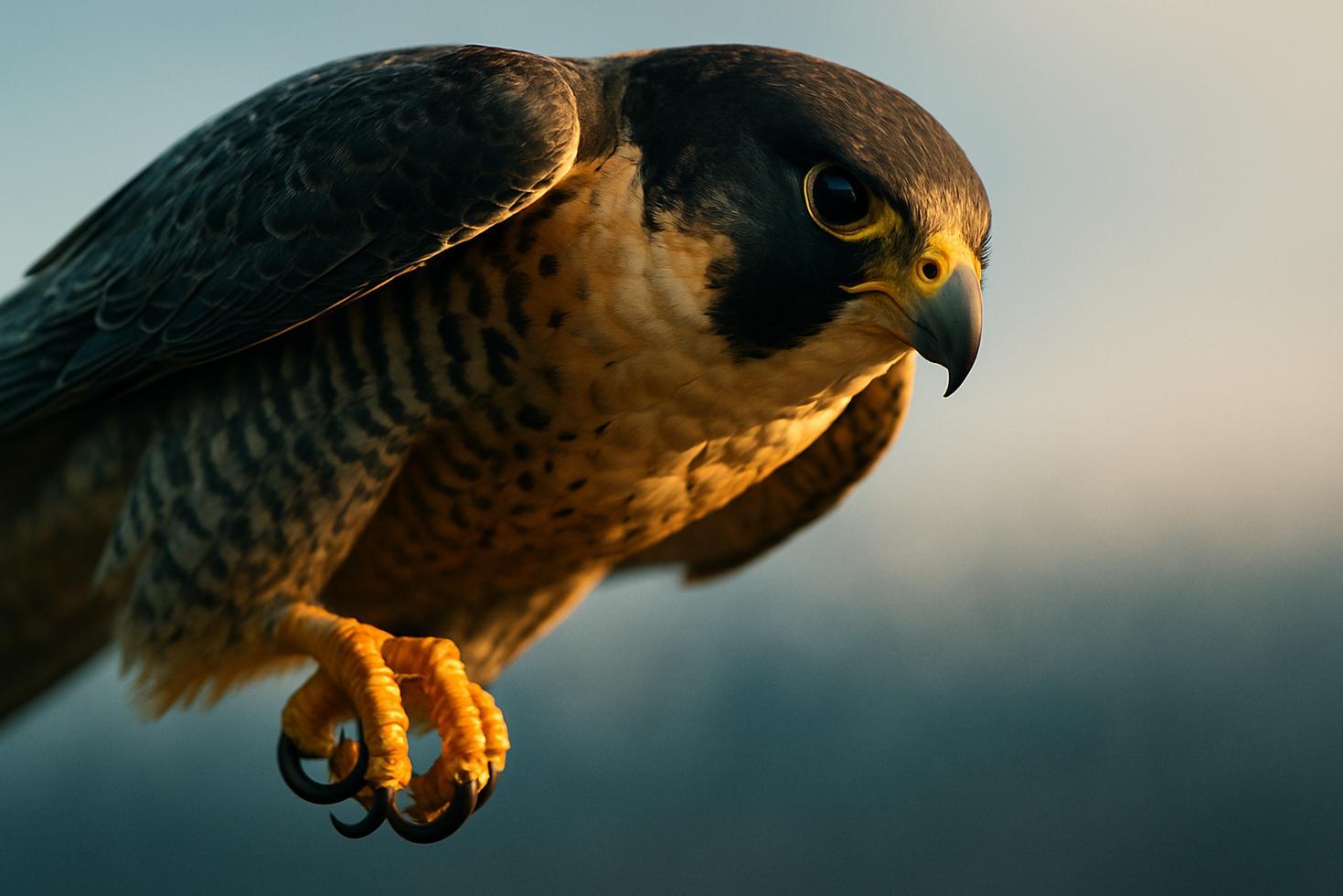
A single instrumented peregrine hit 242 mph in a stoop — and the clenched talon wasn’t shielding against airflow. It was controlling the collision itself.
Peregrine falcons strike prey with talons at least partially clenched, functioning as a compact striking surface rather than an open grasping hand. That detail sounds small until the speed enters the picture: 242 mph, recorded via onboard computer chip on a trained bird named Frightful in 2005, diving from roughly 3 miles altitude — the fastest reliably documented animal movement on Earth.
What makes that number stranger is what happens at the moment of contact. The strike isn’t a stopped punch. It’s a controlled, angled, glancing blow — enough to stun or destabilize prey mid-air, not enough to shatter the falcon’s own anatomy in the process.
What Peregrine Falcon Anatomy Actually Does at 242 mph
The falcon’s body is teardrop-shaped, minimizing drag across the entire stoop. Wings sweep back to reduce turbulence. Bony tubercles inside the nostrils deflect and slow incoming air, preventing lung damage at speeds that would otherwise overwhelm normal respiration.
The eyes get their own solution: nictitating membranes — transparent third eyelids — slide across to protect the surface while keeping vision sharp. Bony nostril tubercles managing airflow are the reason a bird can breathe normally while accelerating past 200 mph, and no other animal structure quite parallels it.
Why the Talon Clenches — and Why “Glancing” Is the Point
No peer-reviewed source supports the idea that an open talon would be aerodynamically shredded at stoop speeds. Talons are small relative to the falcon’s body, and keratinous foot structures are robust enough for normal flight conditions. The clenching behavior is about impact mechanics, not self-preservation from airflow.
At full head-on contact, the physics would be catastrophic for both animals. Instead, an angled strike transferring momentum laterally stuns the prey, sends it into an unrecoverable spin, and lets the falcon survive the exchange intact. The falcon then loops back and collects what has fallen.
Expert biologists note that many strikes are glancing blows rather than single absolute kill impacts, even when prey dies quickly. The stoop delivers momentum. The angle controls where that momentum goes.
Closing
Three miles of acceleration compressed into one angled instant. The 242 mph figure is well-documented, the talon behavior is well-described, and the mechanism connecting them — controlled momentum transfer rather than brute force — is what makes the whole sequence physically coherent. The speed was never the weapon on its own. The geometry of the strike was.
Frequently Asked Questions
How fast can a peregrine falcon actually dive?
The best-documented stoop speed is 242 mph (389 km/h), recorded from an instrumented peregrine in 2005; some radar studies suggest reliably measured speeds closer to 114 mph (184 km/h) in other contexts.
Does the peregrine falcon clench its talons to protect them from wind at high speed?
No scientific source supports that claim. Talon clenching creates a compact striking surface for impact control, not aerodynamic protection.
Does the falcon kill prey on contact during a stoop?
Often the strike is a glancing, stunning blow; the falcon frequently circles back to retrieve prey that has fallen rather than delivering a single stopped kill impact.
What protects a peregrine’s eyes and lungs during a 242 mph dive?
Bony nostril tubercles slow incoming air to protect the lungs; nictitating membranes shield and maintain eye function at extreme speeds.