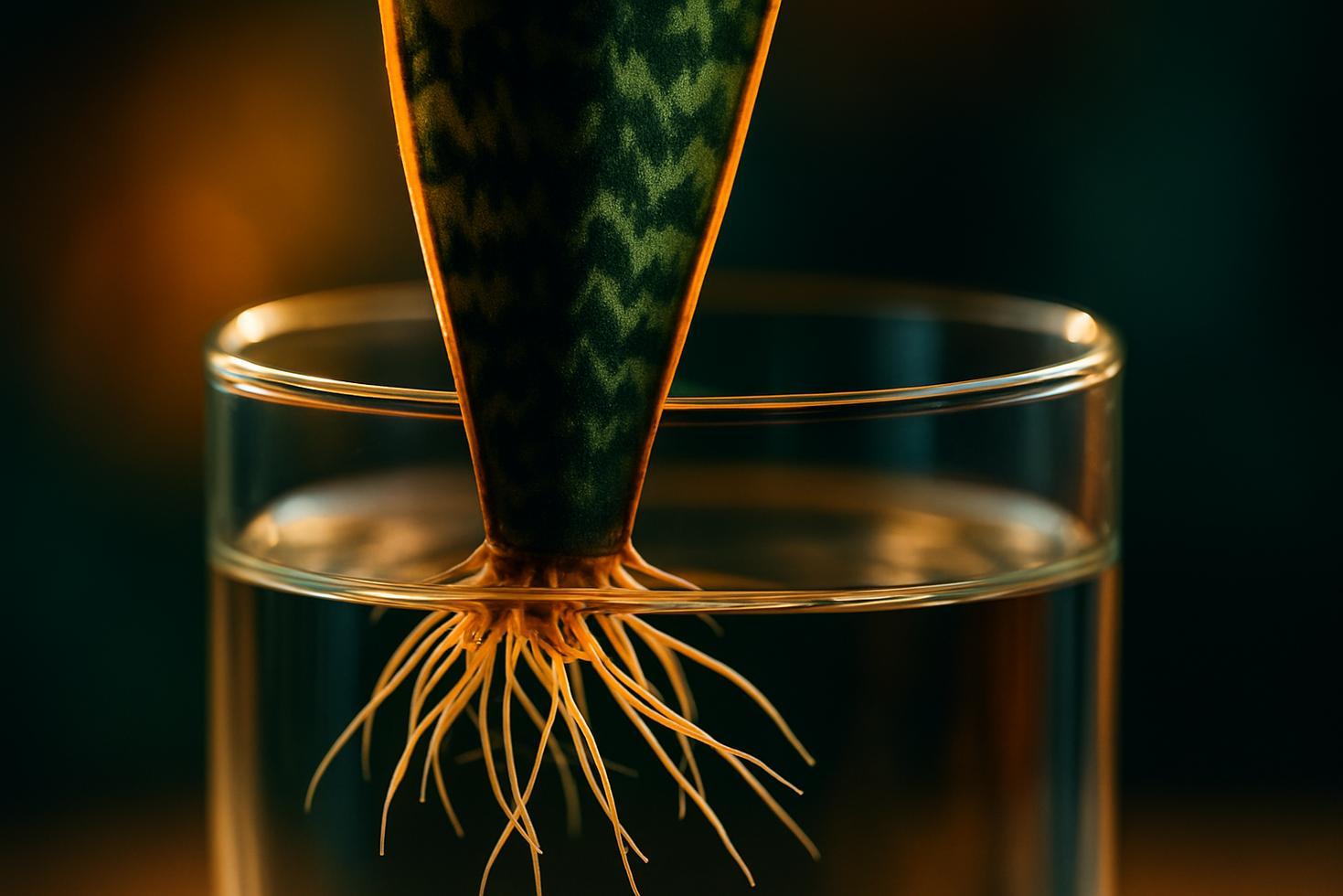
White water roots appear in 3–4 weeks of immersion — thinner, less lignified, and missing the internal air channels that keep aquatic plants alive below the surface.
When a snake plant sits in water, it generates an entirely new set of roots — structurally distinct from anything it grows in soil. That discovery surprises most people who have watched those bright white filaments appear in a glass and assumed the plant was thriving. It isn’t thriving. It’s running a short-term survival protocol.
Snake plants (Sansevieria, now often classified as Dracaena) are xerophytes — built for seasonally dry, well-drained soils. Their thick rhizomes store water and nutrients in densely packed parenchyma cells, a design optimized for drought, not immersion.
How Soil Roots and Water Roots Differ Structurally in Snake Plants
A typical soil root is a layered system. The epidermis carries root hairs — roughly 5–17 micrometres in diameter and up to 1,500 micrometres long — that dramatically expand absorption surface area. Beneath that sits the cortex, then the endodermis with its Casparian strip, which acts as a checkpoint controlling what enters the transport tissue.
Water roots skip much of that architecture. They are thinner, less lignified across the cortex and cell walls, and lack the structural reinforcement that lets soil roots push through packed substrates and regulate mineral uptake. They form fast because none of that costly construction is required when there is no mechanical resistance and nutrients arrive dissolved in the surrounding liquid.
Why the Absence of Aerenchyma Matters for Submerged Snake Plant Roots
True aquatic plants — lotus, water hyacinth, wild rice, mangroves — develop aerenchyma: air-filled channels running through root cortex that pipe oxygen from shoots down to tissues buried in oxygen-poor water. Snake plants never evolved this tissue.
In standing water, oxygen diffuses slowly through the liquid and depletes quickly around dense rhizome tissue. Ethylene production under prolonged hypoxia then accelerates — ethylene is a stress hormone that triggers cell senescence and breakdown. The roots don’t fail from bacterial rot alone. Oxygen starvation precedes and enables it.
This is why simple water in a glass cannot approximate a hydroponic setup. Hydroponics requires active aeration and mineral management. Stagnant water in a vase does neither.
Closing
Those white roots in the glass are not a sign the plant found a better habitat. They are fragile, temporary structures generated under physiological stress — functional just long enough to buy time. Once subjected to mechanical pressure or mineral imbalance, they often collapse entirely, forcing the plant to rebuild soil-adapted roots from the rhizome up.
Survival and growth can look identical from the outside. The root tissue knows the difference.
Frequently Asked Questions
Do snake plants grow faster in water than in soil?
No controlled studies support this. Optimal snake plant growth occurs in well-drained potting mix with intermittent watering, not in standing water.
How long does it take for snake plant water roots to appear?
White water roots typically appear within 3–4 weeks of immersion, though they are fragile and not built for long-term structural integrity.
Why do snake plant roots rot in water?
The plant lacks aerenchyma, so submerged tissue becomes hypoxic. This triggers ethylene-mediated cell breakdown and creates conditions favorable for pathogens.
Can water roots be transplanted into soil?
Water-formed roots are less lignified and structurally weaker than soil roots. They frequently collapse under the mechanical stress of transplanting, requiring the plant to regenerate soil-adapted roots.