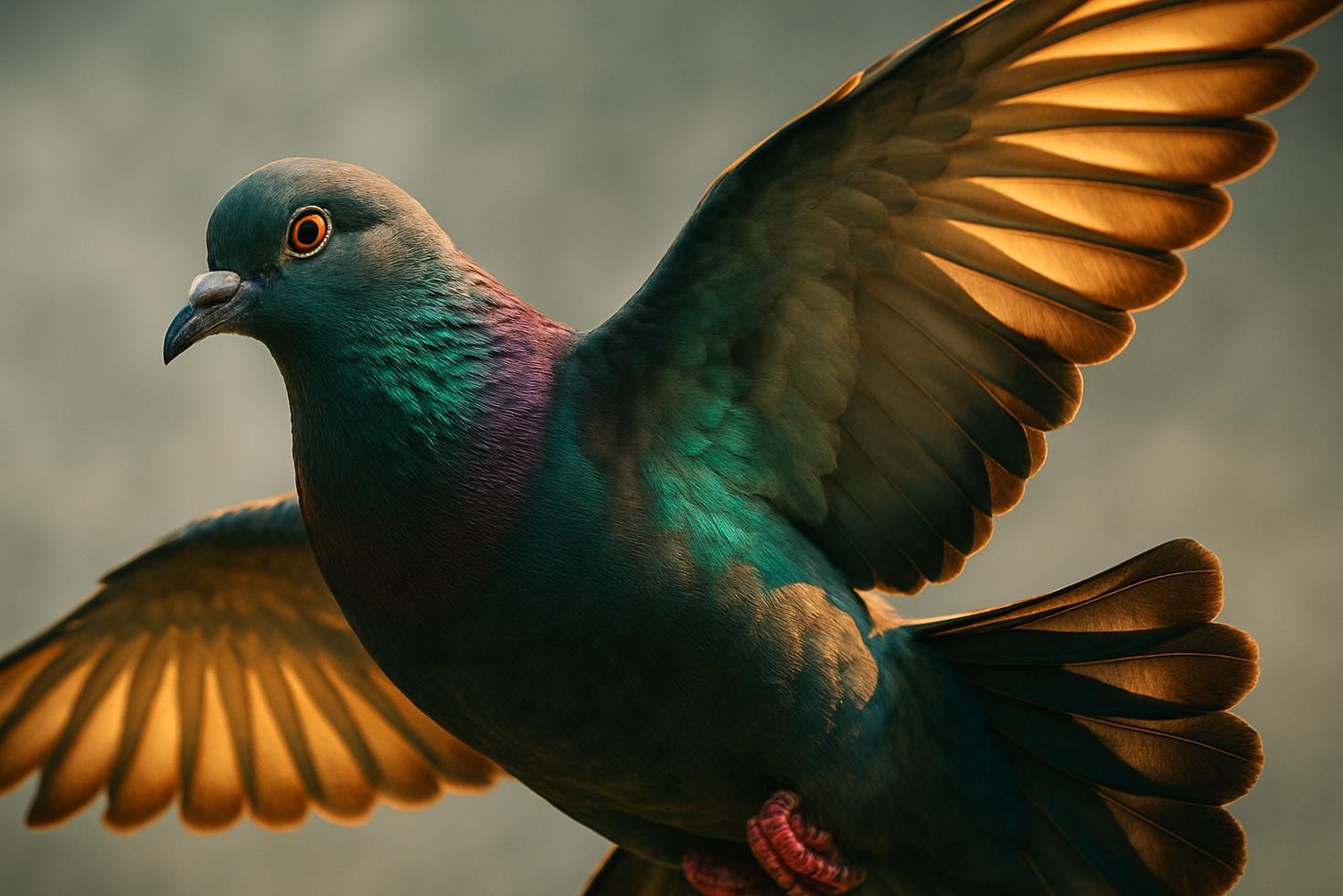
Iron-rich immune cells in a pigeon’s liver can detect fields as weak as 1.86 gauss — remove them under overcast skies, and the bird’s orientation vanishes entirely.
Iron-rich macrophages inside a homing pigeon’s liver function as magnetic sensors, giving the bird directional information from Earth’s geomagnetic field. That finding, published in Science, solved a puzzle researchers had been circling for decades. The cells aren’t exotic structures built for sensing — they’re ordinary immune cells that break down old red blood cells, accumulating iron until they become superparamagnetic.
The liver isn’t the whole story. Pigeons layer magnetic sensing onto sun position, olfactory gradients, visual landmarks, and possibly infrasound — a redundant navigation stack that took surgical cell depletion just to pick apart.
How Liver Macrophages Became a Magnetic Compass
Macrophages constantly break down aging red blood cells. That metabolic housekeeping generates iron accumulation as a byproduct. Enough iron, concentrated inside a single cell, produces superparamagnetic properties coupling to weak fields — weak enough to respond to Earth’s geomagnetic field.
In the experimental work, depleting these cells specifically impaired orientation on overcast days. Sunny-sky performance was unaffected, because the birds shifted to solar cues. The gap only appeared when the sun compass went dark.
Why Pigeons Use Multiple Navigation Systems Simultaneously
No single cue dominates pigeon navigation. Sun position, olfactory gradients, visual landmarks like roads, infrasound, and gravitational anomalies all contribute. GPS-tracking studies have even shown pigeons making right-angle turns at familiar road intersections.
Eye-based cryptochrome proteins using the radical-pair mechanism add another magnetic layer, one disrupted by radio-frequency noise rather than by depleting liver cells. These are distinct systems, not redundant copies of the same sensor.
The beak-iron hypothesis dominated research for decades before a 2012 study disproved it, redirecting the field toward the mechanisms now confirmed.
Wartime Proof That the System Works Under Pressure
Military use during both World Wars tested pigeon navigation under conditions no lab could replicate. Radio lines failed; pigeons didn’t. Cher Ami, a U.S. Army Signal Corps pigeon, delivered a critical message in October 1918 from the trapped Lost Battalion of the 77th Division. Shot through the breast, one leg nearly severed, the bird completed the flight. Artillery fire was corrected. Roughly 194 men survived. France awarded Cher Ami the Croix de Guerre.
The bird wasn’t navigating heroically. It was navigating home.
A system built from immune cell waste products, refined by evolution, and stress-tested across two world wars — homing pigeon navigation keeps revealing new layers the longer researchers look. The liver turned out to be a compass. What else is hiding in plain biology?
Frequently Asked Questions
How far can a homing pigeon actually navigate?
Documented homing distances reach roughly 1,000 kilometers (about 600 miles), supported by both racing records and wartime use.
What exactly makes liver macrophages magnetic?
They accumulate iron while breaking down old red blood cells, reaching concentrations that produce superparamagnetic properties responsive to Earth’s geomagnetic field.
Do pigeons lose all navigation if their liver macrophages are removed?
Only partially — orientation fails under overcast skies, but pigeons retain normal homing ability when sunlight is available, using solar cues instead.
Did homing pigeons actually receive military medals?
Yes. Cher Ami was awarded the French Croix de Guerre for the 1918 Lost Battalion mission and is preserved at the Smithsonian Institution.