
Nutsedge, also known as nutgrass, resembles pale-green grass but is classified as a weed. This plant has very deep, adventitious roots.
Although it starts quickly in damp areas, it can thrive in arid soil once established.
It is rugged and fast-growing, especially in sweltering weather. For this reason, it can overtake your favored grass in the heat of the summer.
Because it has deep roots that spread via rhizomes, it can be challenging to control and eradicate.
This article discusses nutsedge control and lawn-care management strategies, and presents the eight best herbicides for killing nutsedge.
Read on to learn more.
Why Not Grow Nutsedge As Grass?
It might seem that nutsedge would be a good grass alternative since it looks like grass and is much more rugged than most grasses.
However, the problem with growing a lawn of nutsedge is that it’s not controllable.
It doesn’t grow evenly, and it doesn’t present an attractive appearance.
The plants’ rambling roots run willy-nilly, producing rhizomes (nutlets) that sprout young nutsedge plants hither-thither and yon.
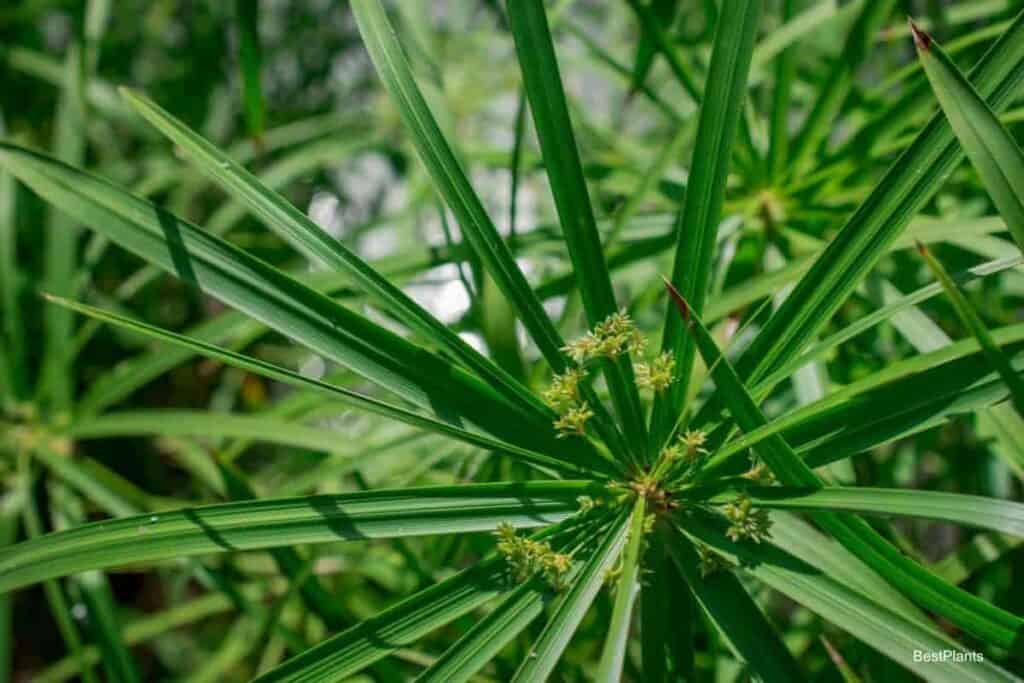
If you allow it to mature, it will also produce seed heads that the wind and birds will scatter, ending up in all sorts of places.
For these reasons, a lawn of nutsedge would consist of random patches of the plant, some just a foot or so across and some as wide as 10 feet.
How Can You Get Rid Of Nutsedge?
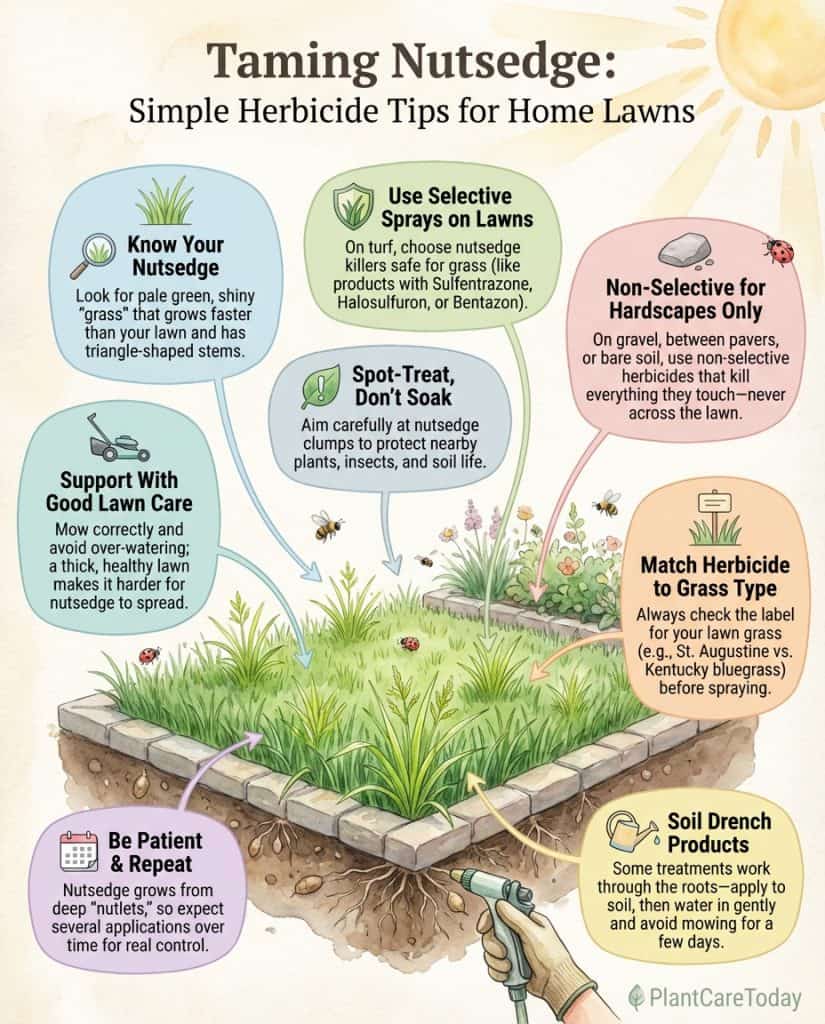
Combining specific and non-specific herbicides with sound lawn-care management practices can help control and eradicate nutsedge.
Here are eight top picks in herbicides that are effective against nutsedge:
Ortho Nutsedge Killer Ready-To-Spray
Ortho Nutsedge Killer Ready-To-Spray is a selective herbicide (Sulfentrazone) that can be used on your lawn because it is safe for both Northern and Southern turf grasses.
Additionally, it is rainproof and effective against both recently sprouted and mature nutsedge.
You can expect results in just a couple of hours with this product.
Ortho GroundClear Super Weed & Grass Killer
Ortho GroundClear Super Weed & Grass Killer is a fast-acting, non-selective combination herbicide.
Examples are:
- Diquat dibromide
- Fluazifop-P-butyl
- Dicamba
- Dimethylamine salt
This can be used on gravel, between pavers, and around desired plants in landscape beds.
This herbicide kills everything it touches, so you don’t want to use it on your lawn, but it is a good choice in areas where you want to eradicate nutsedge and other weeds.
Spectracide Weed Stop For Lawns & Crabgrass Killer
Spectracide Weed Stop For Lawns & Crabgrass Killer is an excellent choice for eradicating nutsedge and other sedges, such as crabgrass.
It contains chemicals (Sulfentrazone and Quinclorac) that are specially targeted to kill these plants, yet it is safe for use on many common lawn kinds of grass, such as:
- Kentucky Bluegrass
- Bermuda Grass
- Buffalo Grass
- Ryegrass
- Fescue
- Zoysia
Take note that you should not use this product if your lawn consists of:
- Centipede Grass
- Saint Augustine
- Bahiagrass
Although you will probably see immediate results with Spectracide, you may need to apply it many times to achieve lasting results.
Follow packaging directions carefully.
Bonide Sedge Ender
Bonide Sedge Ender also contains Sulfentrazone as its primary active ingredient, but it doesn’t include Quinclorac.
Because of this, it is a widely used herbicide for controlling a wide variety of broadleaf weeds, including nutsedge.
In addition, this formulation is safe for a wide range of common turfgrasses.
Image
Image is a product that targets nutgrass roots.
Here are the steps for using this herbicide:
- First, apply it directly to the soil.
- Then water it thoroughly, to about 1/2 inch.
- Allow the water to soak deeply into the ground for a couple of days before mowing or otherwise disturbing the application.
This chemical (Imazaquin) is effective against all sorts of grassy weeds, but it is safe for most turf grasses, including:
- Saint Augustine
- Centipede grass
- Bermuda grass
- Zoysia
If your lawn consists of:
- Kentucky Bluegrass
- Ryegrass
- Fescue
Or other cool-season grasses, this is not the herbicide for you.
Sedgehammer
Sedgehammer is another selective herbicide formulated specifically for the eradication of sedges.
It is effective against the following:
- Purple nutsedge (Cyperus rotundus)
- Yellow nutsedge (Cyperus esculentus)
It is also safe for use on any turfgrass.
It is a reasonably slow-acting chemical (Halosulfuron-methyl), so you may not see results for several days.
Additionally, you will need to apply it several times to get lasting results.
Basagran
Basagran is a good choice as a spot treatment.
It is a foliar herbicide, so it kills the plant on contact with the foliage. It should be applied quite heavily and in a very focused manner.
This chemical (Bentazon) can be safely used on all common mature lawn grasses.
However, you should not use it soon after sowing seed or setting sod.
Wait until your lawn is very well established before using this product.
Roundup
Roundup is a non-selective herbicide that effectively kills everything it touches.
Its main ingredient (glyphosate) enters the nutrient uptake system of all sorts of plants and desiccates them completely.
It will undoubtedly kill nutsedge, but it will also kill anything else it comes in contact with, so it’s not a good choice for lawn care unless you use it as a spot treatment or during the dormant season for the type of grass you have planted.
If you have nutsedge or other undesirables growing in your gravel drive, between pavers, or in other areas where you want to eliminate all vegetation, Roundup is a good choice.
How Can You Keep Nutsedge From Taking Hold?
Lawn management is essential in discouraging nutsedge.
Maintaining an evenly lighted lawn with consistent watering and drainage across all areas is especially important because nutsedge tends to establish in low, damp, shady areas.
Once it has sunk its roots a foot or so down into soft, wet soil, it will begin traveling throughout your lawn.
Proper mowing is another aspect of lawn care management that is critical for controlling nutsedge.
While you might think mowing close would discourage it, it actually has a harder time growing in a slightly taller lawn.
Longer grass will crowd out. Very short grass allows it to take over.
Note that hand-weeding is, for the most part, ineffective at controlling nutsedge because its root systems are so extensive.
Even so, if you catch your nutsedge infestation early and start weeding when the plants have only 5 or 6 leaves, you may be able to wear them out eventually.
Of course, this is only true if you frequently weed until you no longer see the plants returning.
Likewise, if you can completely dig up a small patch of nutsedge, you may be able to eradicate it.
You’d need to dig about a foot deep and a foot around the perimeter of the nutsedge patch. [source]
How Long Does It Take To Eradicate Nutsedge?
It can take several years to eliminate this tough weed completely.
But, even then, you should always be on the lookout for its return because both seeds and wandering roots can spread it.
A good plan for nutsedge control includes proper lawn care and management as described above, along with wise use of pre-emergent herbicide late in the fall and focused control of mature weeds throughout the growing season.