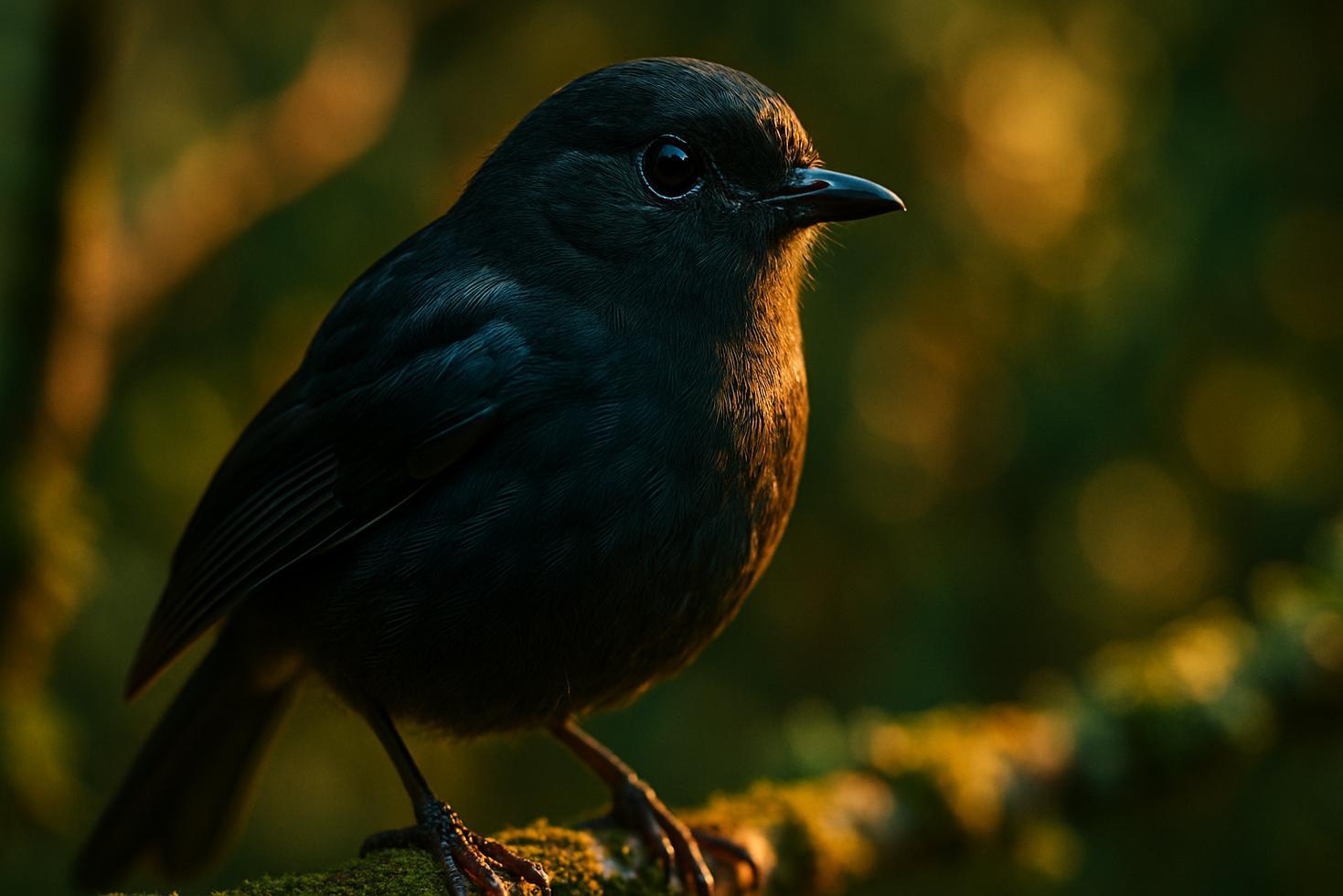
One breeding pair remained in 1980. Today ~290 birds exist — and a 2022 genomic study confirmed this is arguably the world’s most inbred bird species.
All living Chatham Island black robins — roughly 250 to 300 birds — descend from a single breeding pair that survived the 1980 population crash. The female of that pair, known as Old Blue, is the sole source of every black robin’s mitochondrial lineage alive today. What happened on Little Mangere Island that decade is the most extreme documented vertebrate bottleneck built from a complete breeding record.
Five birds survived in 1980. Three of those five were not breeding. The entire species’ reproductive future rested on one nest.
What the 1,358-Bird Pedigree Reveals About Black Robin Inbreeding
A Lincoln University thesis built a master pedigree of 1,358 black robins. Of those, only 24 individuals — 1.8% — were estimated as non-inbred. The rest carry overlapping ancestry from a single founding pair. The 2022 genomic study found inbreeding coefficients in modern birds ran three to four times higher than in pre-bottleneck genomes from the early 1900s.
Yet the birds kept reproducing. A 1990s DNA fingerprinting study found 66% of black robin eggs survived to fledgling stage — higher than the 42% recorded for the mainland bush robin.
How Conservation Management Shaped the Recovery — and One Unintended Consequence
Recovery required active human intervention: translocating birds to safer islands, controlling predators, and cross-fostering eggs into Chatham Island tomtit nests to increase chick survival. The population climbed from 5 birds in 1980 to roughly 200 by the late 1990s, then to approximately 290 by 2022.
One intervention backfired. Managers initially rescued eggs laid on nest rims rather than inside — a behavior under genetic control, likely via a dominant allele. Rim-laying females reached 50% of the population before managers recognized the pattern. After they stopped rescuing rim eggs, natural selection reduced rim-laying to around 10% of females — evidence that selection can still operate within a nearly uniform genome.
Why the Black Robin Genome Survived What Should Have Broken It
The 2022 genomic study found that total mutational load showed limited change between historical and modern genomes. Harmful mutations did not accumulate sharply after the severe decline. Researchers suggest the species underwent long-term population size reduction beginning 90,000 to 100,000 years ago, which may have gradually purged strongly deleterious alleles before the 1980 crisis arrived.
The two present-day populations on Mangere and Rangatira Islands have been genetically isolated from each other since roughly 1990–1991, driving further drift within each group. Reciprocal translocation between islands is now a core conservation recommendation to slow that divergence.
One breeding female left a genetic signature carried by every bird in both populations. That is not a metaphor. It is the literal structure of their DNA.
Frequently Asked Questions
How many Chatham Island black robins are alive today?
Approximately 290 birds as of 2022, split between Mangere and Rangatira Islands in the Chatham group.
Are all black robins descended from Old Blue?
Yes. All living black robins trace their mitochondrial lineage to Old Blue, the sole breeding female surviving in 1980.
Is the black robin the most inbred bird in the world?
A 2022 genomic study of 52 genomes described it as “arguably the most inbred bird species in the world.”
What is rim-laying and why did it matter?
Some females laid eggs on nest rims rather than inside; this behavior has a genetic basis. It reached 50% of females during early recovery before managers changed protocols, then dropped to ~10% once rim eggs were no longer rescued.