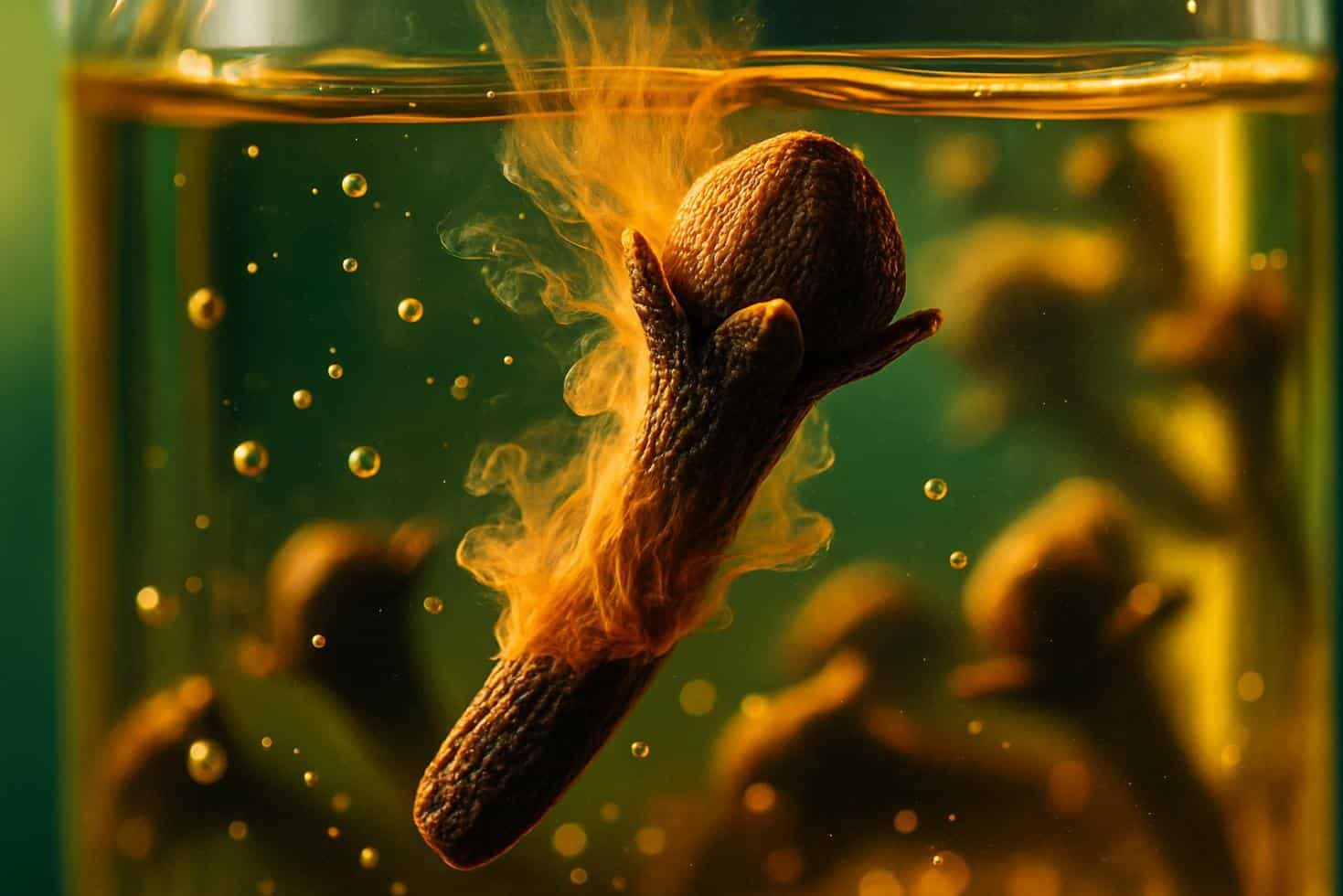
Eugenol drifts from clove tissue into vinegar — but the molecule never changes. True acetylation needs 80°C, a catalyst, and 40 minutes. A kitchen jar just moves it.
Clove-infused vinegar is an extraction, not a synthesis. Eugenol — the phenolic compound making up 70–90% of clove bud oil — simply diffuses out of plant tissue and dissolves into the surrounding liquid. The covalent structure of eugenol arrives in the jar exactly as it left the clove.
That distinction matters. Diffusion moves a molecule. Synthesis changes it. The two processes look identical from the outside — a jar of cloves slowly turning a liquid amber — but the chemistry underneath is completely different.
What Eugenol’s Chemistry Actually Allows at Room Temperature
Eugenol is a weakly acidic phenol with a boiling point around 254°C and modest water solubility — about 2.46 g/L at 25°C. Dilute acetic acid in water dissolves it slowly through passive partitioning.
Acetic acid can hydrogen-bond to eugenol’s phenolic –OH group. That interaction is reversible. It leaves the covalent structure of eugenol completely intact. Hydrogen bonding is not ester bond formation — it is dynamic, equilibrium-based, and produces no isolable new compound.
Kitchen vinegar is roughly 5% acetic acid in water. That concentration, at ambient temperature with no catalyst, cannot meaningfully drive esterification. The chemistry simply has no mechanism to proceed.
Why True Acetylation of Eugenol Requires Far More Aggressive Conditions
To produce acetyl eugenol — an actual new molecule — eugenol’s phenolic –OH must be acylated. That requires an activated reagent. Laboratories use acetic anhydride, not acetic acid, paired with a catalyst such as sodium acetate, pyridine, or a solid heteropolyacid.
Even with acetic acid itself standing in for acetic anhydride, sulfuric acid catalyst plus 75°C only achieves about 59% conversion. Getting to 99% conversion requires 80°C, a 1:5 molar ratio of eugenol to acetic anhydride, and a solid acid catalyst for 40 minutes.
A jar on a kitchen counter produces none of those conditions. The clove steeping in vinegar is releasing what it already contains — not building anything new.
Closing
Clove-infused vinegar carries real eugenol. The compound is present and active. It just traveled there — it did not transform.
The clove is leaking, not reacting.
Frequently Asked Questions
Does eugenol chemically react with vinegar when cloves steep?
No. At room temperature in dilute acetic acid with no catalyst, eugenol diffuses into the liquid but its covalent structure remains unchanged.
What conditions are actually needed to form a new eugenol compound?
Acetyl eugenol formation requires an activated acylating agent (typically acetic anhydride), a chemical catalyst, and temperatures of at least 75–80°C.
Why does 5% acetic acid fail to acetylate eugenol?
Acetic acid is far less reactive than acetic anhydride, and esterification of a phenol requires catalysis and heat to overcome the activation energy barrier.
What is actually in the jar after cloves steep in vinegar?
The liquid contains dissolved eugenol and other clove volatiles extracted by diffusion — an infusion, not a synthesized compound.