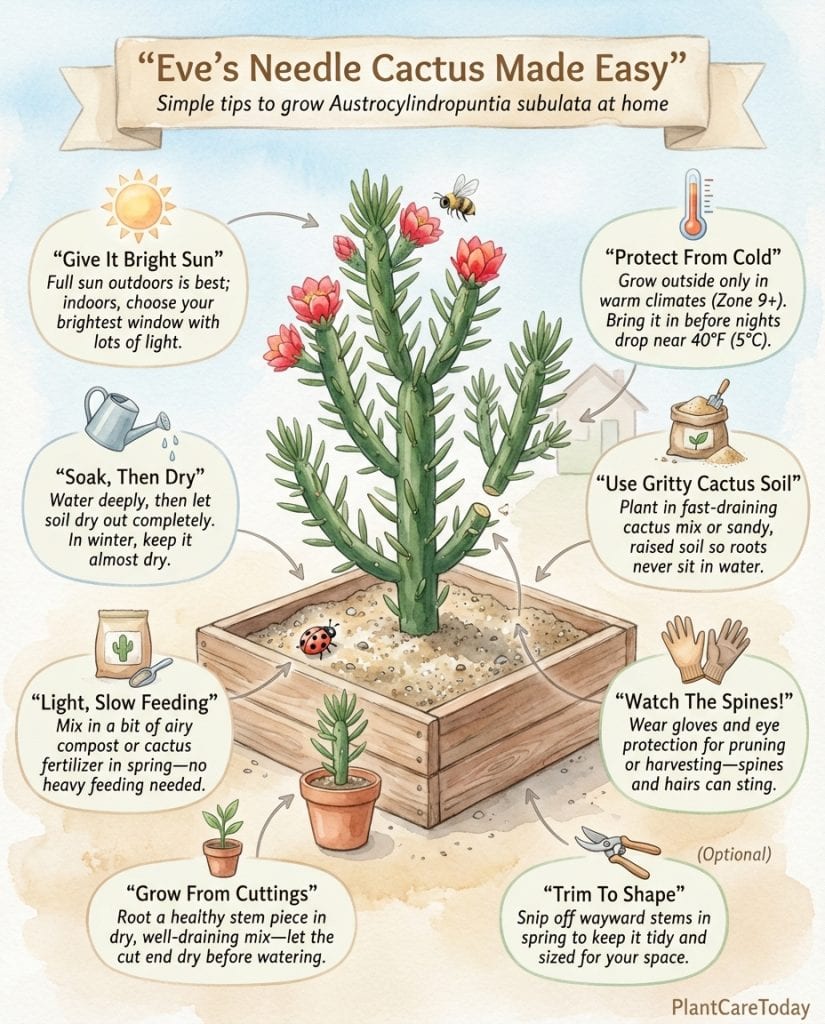
Opuntia subulata [oh-PUN-tee-uh, sub-yoo-LAY-tuh], which is a member of the family Cactaceae, is also known by its alternate scientific name, which is Austrocylindropuntia subulata [oss-troh-sil-in-droh-PUN-tee-uh, sub-yoo-LAY-tuh].
This evergreen, perennial, succulent native of the Peruvian Andes also has several common English names, including:
- Eve’s Pin Prickly Pear
- Eve’s Needle Cactus
- Long Spine Cactus
- Eve’s Pin Cactus
- Cholla Cactus
- Eve’s Needle
- Cane Cholla
- Eve’s Pin
It also has several common Spanish names, including:
- Opuntia de Peru
- Alfileres de Eva
- Chumbera
In this article, we discuss proper care for this interesting, useful plant. Read on to learn more.

Eve’s Needle Cactus Care
Size & Growth
In the wild, Eve’s Pin can reach a height of 12’ feet and a width of 5’ feet. When kept as a houseplant or container plant, its size is naturally limited.
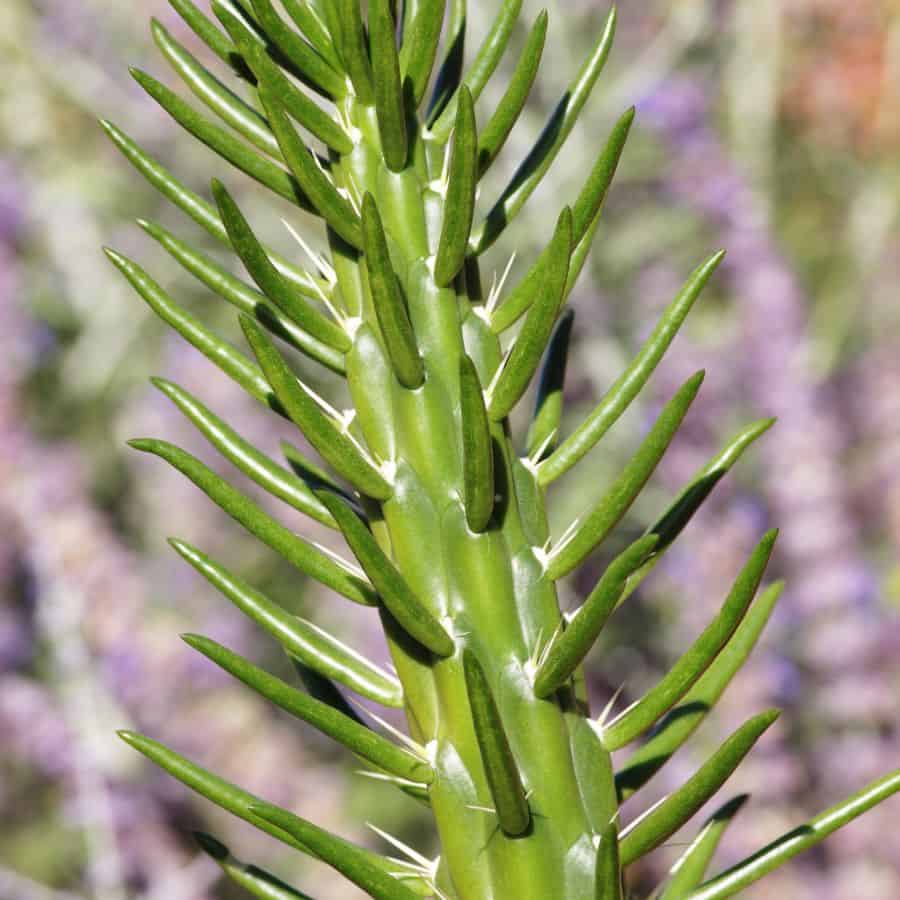
This unusual and attractive cactus grows in a tree-like formation. Its stems are deep green, unsegmented, and cylindrical.
They can grow to be 2” – 3” inches in diameter and are covered with interesting-looking tubercles along the upper stems.
These protrusions explain why the plant has its common pins or needles. They are sharply pointed and semi-cylindrical.
Eve’s Pin Prickly Pear leaves are long-lasting and may persist for a year or more.
They are present at right angles to the plant’s branches and are described as being awl-like.
These leaves are edible and sold as vegetables in many South American markets and in Mexican markets in the United States.
Flowering & Fragrance
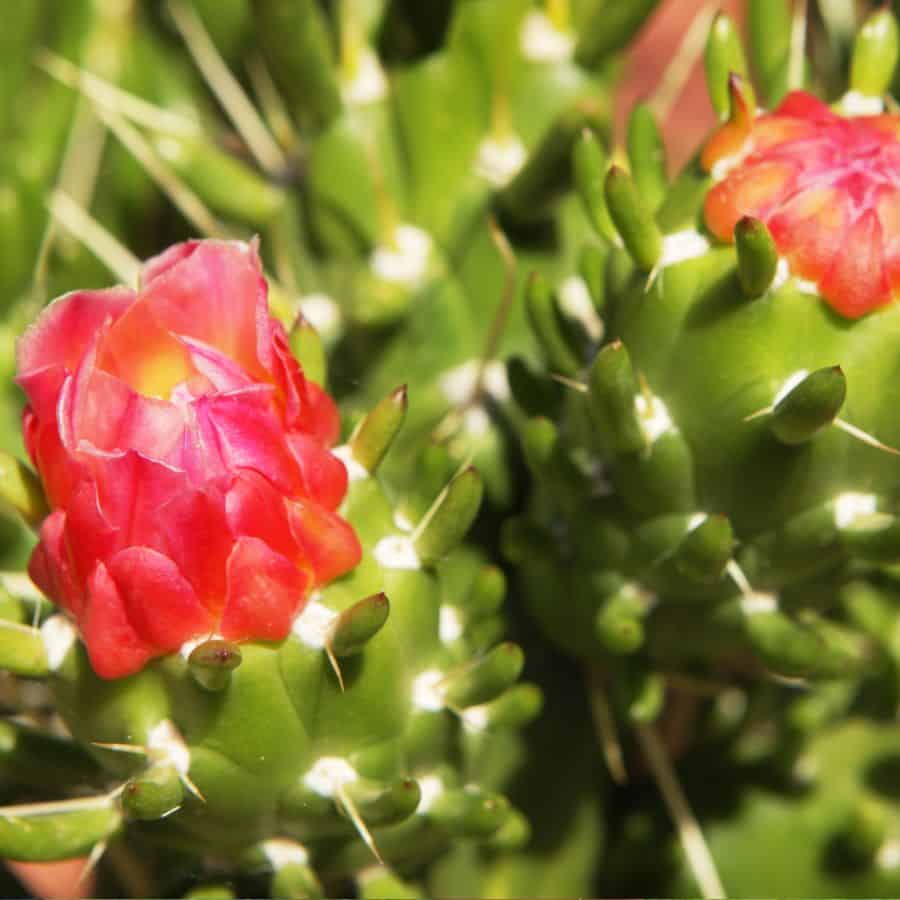
Eve’s Needle produces pretty, red, cup-shaped flowers from mid-spring to mid-summer. The showy blooms are up to 3 inches across and attract desert pollinators.
Flowers are unlikely to occur on plants grown in containers or indoors. Blossoms are abundant and appear at the ends of the branches.
The petals of the blooms are bright rose-red with white at the base. The centers of the flowers are bright yellow or orange.

When the blooms are spent, edible, dark-green, spineless, oblong fruits develop.
Although the fruits are spineless, they are covered with very fine, stinging hairs.
If you’d like, eat the fruit raw; it’s quite tasty; however, it’s also filled with seeds, which are difficult to remove.
The best way to remove the seeds is to cut the fruit in half and scoop them out from the center.
The fruits are fermented to make a cactus wine. The fruits of Eve’s Pin Cactus are vitamin-rich, but the flesh has fairly low nutrient content.
It is tasty and filling, but it’s not recommended for livestock feed because it provides little nutritional value.
When preparing fruits and plant flesh for consumption, thoroughly remove spines and stinging hairs before handling, processing, or eating.
Light & Temperature
Eve’s Pin grows best and fastest in full sun, but it can also do well in partial shade.
Less sun naturally means less growth. Indoors, keep your plant in an area with plenty of bright filtered light.
Long Spine Cactus is extremely heat-tolerant and can grow outdoors year-round in USDA hardiness zones 9 and above, where daytime temperatures are almost always above.
Eve’s Needle cannot tolerate temperatures below 25°F (-4 °C). Generally speaking, you should never keep this plant in an area where the nighttime temperature falls below 41°F (5 °C).
Watering & Feeding
As with most cacti, it’s best to water thoroughly and then allow the soil to dry out completely before watering again.
Water well throughout the growing season, ensuring the plant has good drainage so it is never standing in water.
Water extremely sparingly during the late fall and winter months. In the wintertime, it’s best to keep Eve’s Needle dry.
Furthermore, during the growing season, refrain from watering on very humid or cloudy days.
Opuntia cactus has very low fertilizer requirements. Amend the soil with light, airy organic matter when transplanting and to top-dress at the start of the growing season.
A combination of:
- 2 parts sand
- 2 parts potting soil
- ½ part limestone, bone meal, or peat moss
…makes a good, natural, slow-release amendment for your cactus.
Soil & Transplanting
When keeping this plant in a pot, use a standard packaged succulent or cactus mix as the potting soil.
If you’re growing the plant outdoors, begin with gritty, well-drained soil in a slightly elevated location.
Amend the soil as described above to create a light, airy substrate that will not become soggy.
The best time to repot Cane Cholla is in the spring. Don’t repot too frequently; instead, wait until the cactus is somewhat root-bound.
In most cases, repotting every two years is sufficient. After you have repotted your cactus, withhold water for at least a week.
Grooming & Maintenance
Eve’s Pin Prickly Pear is a fairly maintenance-free plant. Trim wayward stems and paddles as you wish to shape the plant and attain cuttings for propagation.
Cut off flowers as they fade if you do not wish fruits to form. Remove fruits as they ripen.
How To Propagate Austrocylindropuntia Subulata
This cactus are propagated from cuttings, seed, or root segments. The easiest way to propagate this plant is through stem division.
The plant’s pads will root quickly and easily when placed in or on good, well-drained cactus or succulent soil.
To grow from cuttings, choose a healthy-looking section and cut it off cleanly with a very sharp knife.
Be sure to wear protective clothing, gloves, and eye protection when handling this plant, as its spines are sharp and were once used as needles in ancient Peru.
Furthermore, fine hairs on the fruits can produce a stinging sensation.
The hard seeds must be nicked and pre-soaked at 70°F (21 °C) overnight before planting.
Follow standard cactus seed planting instructions for sprouting and early growth.
Separate the plant at the roots and propagate by division.
Protect yourself against sharp thorns and stinging hairs during this operation as well.
Austrocylindropuntia Subulata Main Pest or Disease Problems
This cactus is subject to fungal and bacterial infections, such as:
- Bacterial Soft Rot
- Zonate Leaf Spot
- Cladode Rot
- Black Spot
Careful watering and good air circulation will help keep these problems under control.
When kept as a houseplant, this succulent is also subject to all the usual houseplant culprits, such as scale insects and mealybugs.
Good care and maintenance will discourage them.

Is this plant toxic or poisonous?
According to the American Society for the Prevention of Cruelty to Animals, cacti in the Opuntia species are not toxic to cats, dogs, or horses.
Is this plant invasive?
There are many types of Opuntia, and they are often grown for food or as landscape plants.
For the most part, these cacti are not invasive in the United States; however, they have been known to spread aggressively in Australia, as described in this Australian government resource.
Suggested Eve’s Needle Cactus Uses
These rugged plants are heat and drought-tolerant and withstand high winds and salt exposure.
Additionally, they are quite deer-resistant. This drought-tolerant plant is a good choice for seaside, rock, and desert gardens, as well as for xeriscaping in areas with a consistently warm climate.
Otherwise, Opuntia subulata is great for container gardening or as a houseplant in any climate.