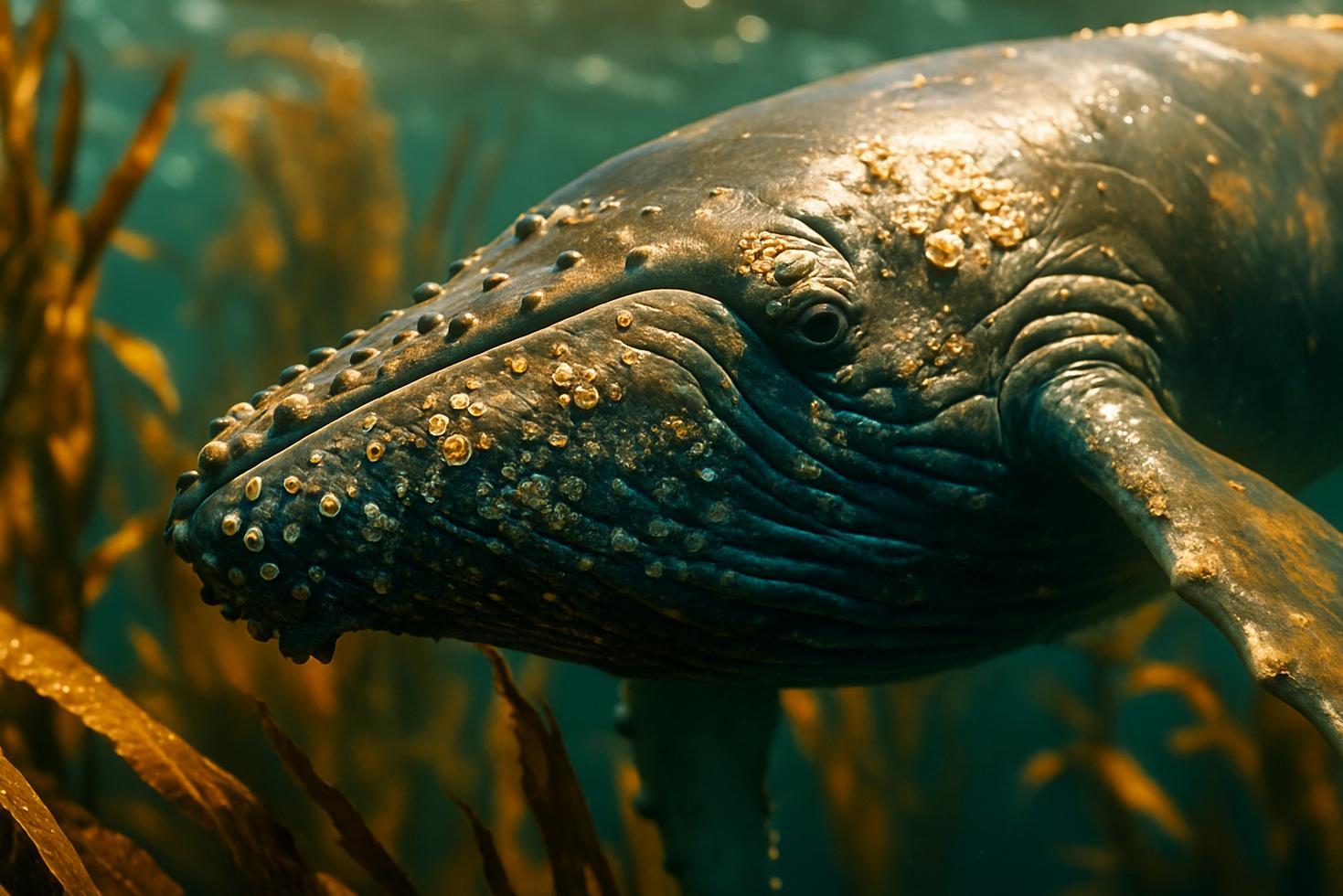
Researchers have logged over 100 kelping events across gray, right, and humpback whales — and in several, multiple whales worked the same strand of seaweed together.
Kelping is a documented whale grooming behavior in which humpbacks, gray whales, and right whales deliberately lift, balance, and roll through seaweed strands. It is not accidental contact. Researchers who compiled observations from social media and field records found more than 100 distinct events across three species. The slow, deliberate rolling these whales perform through kelp fronds looked playful — and researchers concluded it is probably both.
The behavior draws attention because it straddles two categories that rarely overlap: hygiene and play. A humpback lifting a kelp strand onto its rostrum and dragging it across skin folds is doing something that looks purposeful. The friction from kelp’s bladed, rough surface is consistent with how whales groom generally — by rubbing against seafloors, breaching, or migrating to colder water.
What Kelping Behavior Actually Looks Like
Whales approach kelp deliberately and interact with it in repeatable ways. They lift strands, balance them on the flat surface of the rostrum, and roll laterally so the fronds drag across skin. Lifting and balancing kelp on the rostrum is one of the most consistently documented movements.
The playfulness is explicit in the research. Tossing and re-engaging with the same strand, or returning to the same patch, are behaviors researchers categorize as play. Play and hygiene are not mutually exclusive here — both appear to be happening.
Why Kelp’s Friction Matters for Parasite Removal
Whale skin is sensitive, actively shedding, and frequently colonized by whale lice — small amphipod crustaceans that settle into skin folds, scars, and creases. Gray whales in Mexican lagoons have been documented approaching humans repeatedly to have whale lice removed, showing these parasites are genuinely irritating.
Kelp’s blade-like fronds provide mechanical abrasion. Researchers propose this abrasion can dislodge young barnacles before cement attachment hardens permanently. Once a barnacle from the family Coronulidae fuses to whale epidermis, it stays until it dies — roughly one year — and leaves a circular scar. Kelping catches early-stage barnacles and lice. It does not clear established, fully attached barnacles, and the research frames this function as a well-supported hypothesis rather than a proven outcome.
The Social Dimension of Shared Kelp Strands
Several documented events involved more than one whale engaging with the same kelp strand. Whether that reflects social learning, simple attraction to a useful resource, or something else, researchers have not resolved. But the result is consistent: kelp becomes a gathering point.
Whales already use their environment as a grooming toolkit — rocky seafloors, strong currents, open-water breaching. Kelp extending that toolkit into shared social space is the genuinely surprising part of this research.
The ocean has been running this bathhouse for a long time. Researchers just needed a hundred documented visits to notice.
Frequently Asked Questions
What species of whales have been observed kelping?
Gray whales, northern and southern right whales, and humpback whales have all been documented kelping across more than 100 recorded events.
Does kelping actually remove barnacles from whales?
Researchers hypothesize kelping can dislodge young, early-stage barnacles and whale lice. Fully attached adult barnacles are cemented too firmly to be removed this way.
Is kelping considered play or grooming?
Researchers classify it as both. The rolling and balancing movements fit play behavior, and the friction against skin is consistent with grooming mechanisms whales use elsewhere.
How do researchers know kelping is deliberate?
Whales approach kelp and engage with it through repeated, patterned movements — lifting, balancing, and rolling — rather than simply drifting through it, which researchers interpret as intentional interaction.