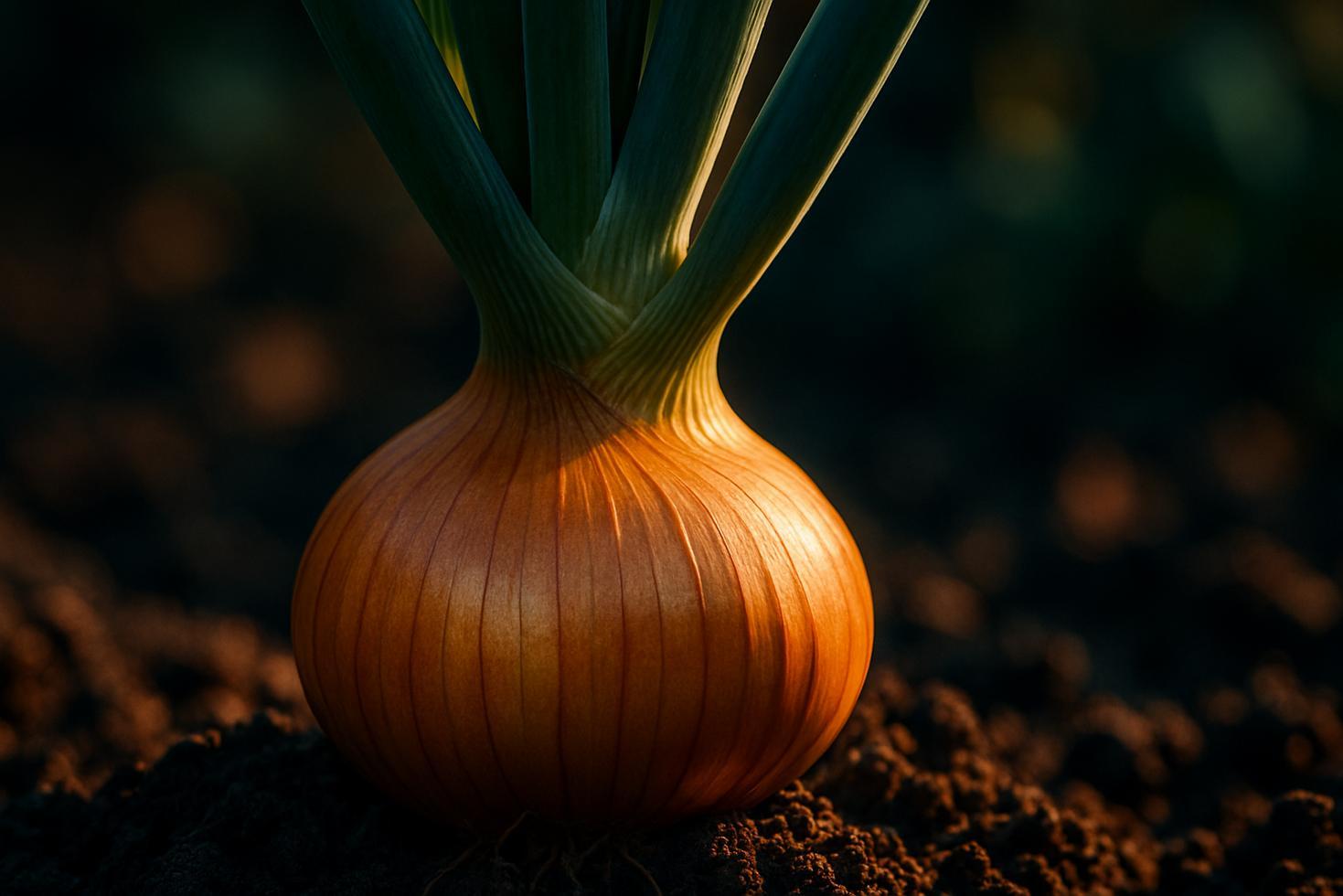
Every ring inside an onion is a thickened leaf base. Most varieties stack 8–12 of them before a single day-length threshold shuts leaf production off entirely.
Onion bulbs are not separate organs the plant builds for storage — they are a compressed stack of modified leaf bases, each one laid down in sequence during the plant’s vegetative phase. That fact reframes what a trip to the kitchen looks like. Slicing through those concentric rings is slicing through a growth diary.
The plant spends its early weeks doing one quiet, measurable thing: adding leaves. At 20°C, a new leaf emerges every 5 days. At 15°C, the interval stretches to every 8 days. Each leaf that forms is also a future ring.
How Onion Leaf Bases Physically Become Bulb Scales
The leaves of an onion are hollow tubes arranged concentrically — each new leaf emerging inside the sheath of the previous one. When the photoperiod trigger fires, blade growth is suppressed while the base of each sheath swells with stored photosynthate. Leaf-base thickening into storage tissue is the mechanism, not a separate organ switching on.
Older outer leaves can dry and wither during this process, so not every leaf top the plant produced necessarily survives as a distinct outer ring. The internal count remains more reliable than the external wrapper.
How Day Length Sets the Final Ring Count
Photoperiod is the primary environmental lever. Once day length crosses a variety-specific threshold — somewhere between 11 and 16 hours of light — the growing point stops initiating new leaves. Whatever the plant assembled before that moment is exactly what it has to work with.
Most varieties cross the bulbing threshold after six to eight leaves have formed. Vegetative growth can extend to 8–12 leaves under the right conditions. Each additional leaf added before the trigger represents one more layer available to the finished bulb. The math closes at the moment the light threshold is crossed.
What Temperature Does — and Doesn’t Do — to Bulb Formation
Temperature shapes how fast leaves accumulate before the photoperiod trigger arrives, not whether bulbing happens. Optimal leaf development occurs between 20–25°C. Temperatures between 7.2–10°C can drive bolting rather than bulbing.
At 20°C, five days per leaf means more total leaves can stack up in a given window before critical day length arrives. At 15°C, the slower pace — one leaf added every eight days — compresses the final count.
Those concentric rings are a record of time, temperature, and a single light threshold the plant was quietly measuring all along. The bulb doesn’t get built. It gets revealed.
Frequently Asked Questions
What are the rings inside an onion made of?
Each ring is a thickened leaf base — the basal sheath of a leaf the plant produced during its vegetative phase, enlarged into storage tissue once bulbing began.
What triggers an onion to stop making leaves and start forming a bulb?
Day length crossing a variety-specific threshold between 11 and 16 hours of light triggers bulbing; new leaf production stops roughly 25–30 days after that long-day period begins.
Does more leaves mean a bigger onion?
Generally yes — more leaves before the photoperiod trigger provides more leaf-base tissue to redirect into bulb scales, resulting in a larger finished bulb.
Why do some onions have more rings than others?
Variety, temperature during vegetative growth, and conditions that affect leaf emergence rate all determine how many leaves form before the day-length threshold is crossed.