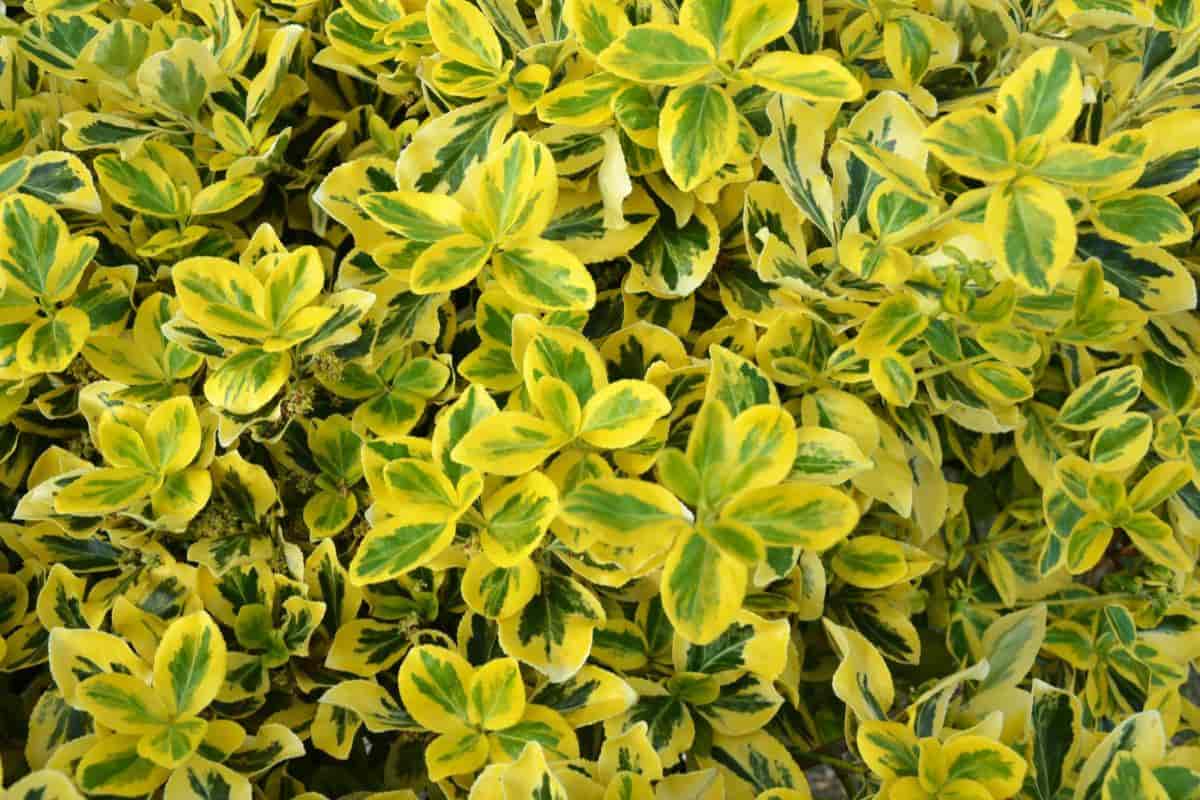
The high color and interest of natural roadside plantings which is well worth driving for miles to enjoy, may be repeated in one’s garden for permanent pleasure by giving proper attention to the selection and use of shrubbery in border and specimen plantings.
The clear, bright red of the winged euonymus, or burning bush, Euonymus alatus, was once a keynote of the autumn garden, with its interestingly-formed winged twigs showing after the leaves drop. It is now an invasive shrub. Birds spread its fruit into woodlands, where it forms dense thickets. It is illegal to buy or plant in Pennsylvania, and it is a Restricted Noxious Weed in Minnesota, where the dwarf form, Euonymus alatus compactus, is covered too; only the seedless cultivars ‘NCEA1’ (Fire Ball Seedless) and ‘ZeroSeed’ are exempt there. For red fall color, use native shrubs instead, such as red chokeberry (Aronia arbutifolia), gray dogwood (Cornus racemosa) or native viburnums.
Euonymus For Fall Color
Several of the deciduous species of euonymus entertain colorful fruits, which become more conspicuous as the foliage drops after killing frosts occur.
Euonymus Atropurpureus
The fruits of the Eastern wahoo, E. atropurpureus, show a surprising pomegranate-purple color not found elsewhere in the garden. Winterberry euonymus, E. bungeanus, holds its generous display of two-toned fruits well into the cold winter months.
Euonymus Fortunei Coloratus
Purple-leaf winter-creeper, Euonymus fortunei coloratus, an evergreen vine whose foliage turns a rich bronzy purple in the Autumn, is no longer a good choice. Wintercreeper is now an invasive vine that aggressively invades forest edges and openings, and Pennsylvania lists it as an invasive plant. For fall color, use the native Eastern wahoo, above, or the chokeberries, below.
The Elaeagnus Are Eligible
Out of the singular metallic, wooly gray twigs of cherry Elaeagnus, Elaeagnus multiflora, emerge clusters of silvery pink berries which follow the pink bloom of the early summer. This shrub, of easy culture, adapts itself well to any sunny exposure.
Autumn Elaeagnus, or autumn olive, E. umbellata, is taller, growing to 12′ feet, but it should not be planted. It is now an invasive shrub that has become a serious weed in pastures and other open ground. It is a Restricted Noxious Weed in Minnesota, where it may not be sold, and Wisconsin and Pennsylvania list it as invasive.
Of particular interest to those who enjoy seed pods or the effect of ripened dried plant parts is the shrub known to many as summer-sweet, Clethra alnifolia, which blooms in the late summer.
Its fragrant white flower spikes are followed by graceful seed heads, which last through the winter.
Drooping leucothoe likewise carries a ripened brown, terminal seed spike and, at the same time, rich, fleshy brown buds for the next season’s bloom. A deep bronze tinges its evergreen foliage, making it a truly year-round classic for the garden.
Another broad-leaved evergreen that is distinctive in its grape-like fruiting habit is the Oregon holly grape, Mahonia aquifolium. Two easily grown varieties of holly also set black fruits, the inkberry, Ilex glabra, and the Japanese holly, I. crenata.
Berry-Bearing Viburnums
Some of the most choice varieties of shrubs in the summer garden are the following:
- American cranberry bush, Viburnum trilobum, with its heavy clusters of bright cranberry-red fruits.
- Black-haw, V. prunifolium combines fresh pink to bluish-black fruit as it ripens with deep bright red to purple Autumn foliage.
- Leather-leaf viburnum, V. rhytidophyllum, has a bold tapestry-like evergreen leaf, providing a rich setting for its red to black fruit.
- The nannyberry, V. lentago is a black-fruiting species.
- Yellow-berry linden viburnum, V. dilatatum xanthocarpum, is a form of linden viburnum, which is now considered invasive. Birds spread its abundant fruit, and Pennsylvania lists linden viburnum as an invasive plant. Choose one of the native viburnums above, such as American cranberry bush, black-haw or nannyberry, instead.
In the taller shrub group, suitable for heavy borders:
- Sapphire-berry or sweet-leaf, Symplocos paniculata
- Not the buckthorns, Rhamnus frangula (glossy buckthorn) and R. davurica (Dahurian buckthorn): both are now invasive. Birds spread their black fruits into woods and wetlands, where they form dense thickets that crowd out native plants. Glossy buckthorn and all its cultivars are a Restricted Noxious Weed in Minnesota.
- European privet, Ligustrum vulgare, is no longer recommended. Pennsylvania lists the imported privets as invasive, aggressive, thicket-forming shrubs. For dark berries, choose native black chokeberry (Aronia melanocarpa), below, instead.
- The common spicebush, Lindera benzoin, grows in a clean, free-branching habit, and its amber-yellow Autumn foliage is further enhanced by bright red berries borne singly on the twigs.
- Both red and black-fruiting varieties of choke-berry, Aronia arbutifolia, and A. Melanocarpa, respectively.
Some With Red Fruits
There are numerous red-fruiting shrubs in addition to those already mentioned. The Common winterberry, Ilex verticillata is one of the most dependable.
The cotoneasters offer some of the most attractive branching patterns lined with red fruits.
Spreading Cotoneaster
- Cotoneaster divaricata is a species with many uses in the garden
- Cranberry cotoneaster, C. apiculata, has the largest fruits of the group
- Sungari cotoneaster, C. racemiflora soongorica, has a raceme.
Red Autumn foliage remaining late in the season gives added textural interest to the red fruits of the deciduous barberries.
Japanese barberry, Berberis thunbergii, and its dwarf variety, B. t. minor, were once favorites where compact plantings were required, but Japanese barberry is now considered invasive. It forms dense, prickly thickets that crowd out native plants, and it is thought to harbor the black-legged ticks that spread Lyme disease. Pennsylvania added it to its noxious weed list in 2021, so it can no longer be sold or grown there. Don’t plant it.
Fruiting Shrubs
White fruiting shrubs are especially important when planning for effective fall landscapes.
Cornus Racemosa
Billowing clumps of gray dogwood, Cornus racemosa, with their gray-white berries on red pedicels, are something to which a gardener may well look forward each year.
Symphoricarpos Albus
The old-fashioned snowberry, Symphoricarpos albus, used at intervals in the shrub border or a mass bank planting, is showy at a good distance, and at close range, its effect is as refreshing as the first snowfall.
Symphoricarpos Chenaultii
Another kind of Symphoricarpos, S. chenaultii, is commonly known as pink coralberry, and Indian currant or coralberry.
Symphoricarpos Orbiculatus
S. orbiculatus, add still another color to the blend of Autumn colors. The purple beauty-berry Callicarpa dichotoma may introduce a purple note in a small fine-textured shrub.
Spring Bloom In The Fall
One of the most pleasant experiences in the garden is discovering an occasional blossom on a Spring-flowering shrub. Likewise, any variety of flowering quince may throw an occasional fall bloom.
Double-file viburnum, V. tomentosum, frequently recurs, although the corymbs are usually smaller in the Fall. Mock orange and weigela also favor us in this respect.
Several Shrubs Bloom in the Autumn
- Winter honeysuckle
- Lonicera fragrantissima, an evergreen or semi-evergreen, is one of the most fragrant of honeysuckles.
- Bluebeard, Caryopteris incana, is unique in being one of the relatively few blue-flowering shrubs. Use it as a low facing for Summer borders or for Fall interest among perennial plantings.
Syringa Microphylla
The fall-flowering little-leaf lilac, Syringa microphylla, adds a charm to a Fall gardenscape which is equal to, but apart from, the lilac display of Spring.
It has a counterpart in the Autumn higan cherry, Prunus subhirtella autumnalis, with its Autumn show of single light pink blossoms.
Clerodendrum Trichotomum
Another shrub, the Harlequin glory-bower, Clerodendrum trichotomum, gives an extended blooming period of loose cymes of white flowers marked with a brownish center during September. The fruit is blue with a crimson calyx.
Hamamelis Virginiana
The witch-hazel, Hamamelis virginiana is one of the most picturesque of native shrubs, with its fragrant twisted blossoms in October and November, last year’s seed pods, and yellow Autumn foliage all at the same time.
Odds And Ends
Some other select shrubs for naturalized effects are:
- Ninebark, Physocarpus opulifolius, with its brown clusters of seed pods;
- Sumacs, with their showy red seed spikes and brilliant red foliage, and the filberts and hazelnuts
- Purple European filbert, Corylus avellana fusco-rubra, provides one of the richest colors and textures in the landscape.
No clashes occur among Fall’s wealth of color, so wherever the form and texture of shrubs are compatible with the physical setting and the function in the garden picture, they may be combined freely.
So a wise gardener will take full advantage of a good selection for a final display at the close of the gardening season.
44659 by Viola Briner