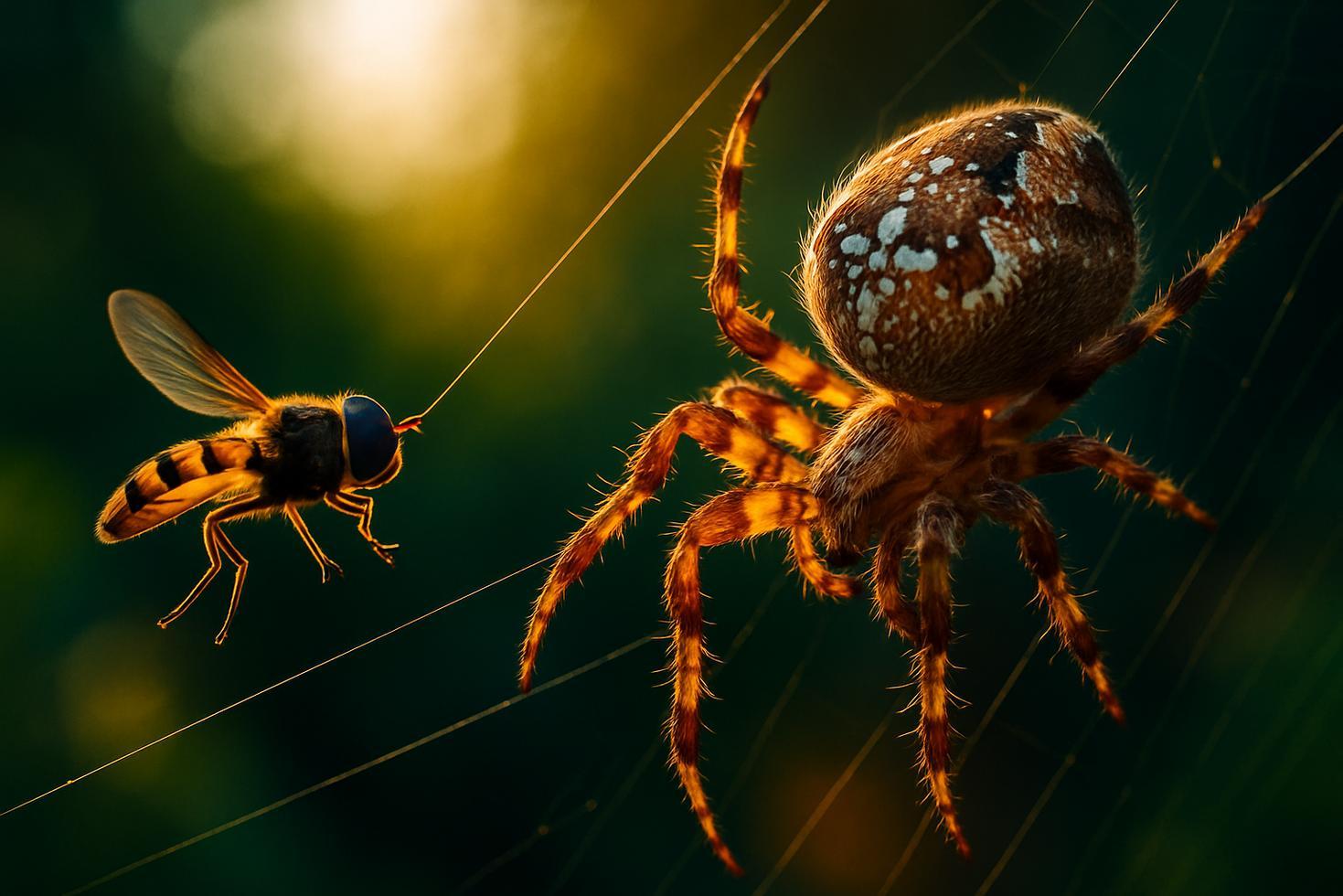
Orb weaver spiral silk flexes 1–2 mm toward charged insects at nearly 2 meters per second — the thread moves to the prey, not the other way around.
Spider silk physically moves toward flying insects before any contact occurs, pulled by electrostatic attraction between opposite charges. That single fact reframes what a spider web actually is. It looks like passive architecture. It behaves like an active electrical field.
Flying insects accumulate positive charge as their wings beat through the air, friction with air molecules driving the buildup. Spider silk, a protein material rich in acidic amino acid residues, tends to carry a negative charge. Opposite charges attract — and the result is measurable, filmed, and repeatable.
In 2013, UC Berkeley researchers Victor Manuel Ortega-Jimenez and Robert Dudley published the controlled experiments in Scientific Reports. High-speed video of Araneus diadematus orb webs showed spiral silk threads deforming rapidly toward electrostatically charged insects. Uncharged insects produced no such deformation.
What the UC Berkeley Experiment Actually Showed
Ortega-Jimenez and Dudley gave dead insects a positive electrostatic charge and allowed them to fall near grounded Araneus diadematus orb webs. High-speed cameras captured individual spiral threads bending toward the charged bodies before any collision. Length-normalized deformations — deflection divided by thread length — ranged from roughly 0.2 to 0.7, depending on object size and charge level.
The spiral capture threads, not the radial frame threads, showed the strongest response. Spiral silk is structurally more compliant and coated with adhesive droplets, so modest electrostatic forces can physically pull it out of position. A charged insect passing near but not through the web could still contact silk that had curved out to meet it.
How Electrostatic Attraction Changes a Web’s Effective Capture Zone
The millimeter-scale reach sounds small. In the geometry of an insect body and an orb web, it is not. Contact with a capture thread is the event that triggers entanglement or adhesion. Extending that contact zone by even 1–2 mm meaningfully raises the probability that a nearby insect touches silk at all.
After contact, electrostatic adhesion supplements mechanical entanglement, holding prey briefly against the silk even in webs lacking sticky coatings. That brief window — long enough for the spider to arrive and wrap the insect — can determine whether a catch succeeds or escapes.
At the molecular level, a separate communication noted that electrostatic forces can trigger a concertina-like deformation in MaSp1, the major ampullate silk protein, suggesting charge begins altering silk’s mechanical state before insect and thread ever physically meet.
The Closing Picture
An orb web is not waiting passively for luck. Its spiral threads carry a charge opposite to nearly every flying insect that approaches, and the physics responds in milliseconds. Pat has spent decades watching spiders, and this mechanism — discovered on high-speed video, invisible to the naked eye — remains one of the more quietly astonishing things in the garden.
The web is already reaching. It just does so at a scale too small to see.
Frequently Asked Questions
Does all spider silk attract flying insects electrostatically?
The effect was demonstrated specifically in spiral capture threads of Araneus diadematus orb webs; stiffer radial threads showed less deformation.
How fast does the silk actually move toward an insect?
In controlled tests, individual silk strands flexed toward charged insects at an average speed approaching 2 meters per second.
Can a web catch an insect that never physically hits it?
Yes — silk threads curved toward the charged insect and contacted it before the insect reached the plane of the web in the UC Berkeley experiments.
Why do flying insects carry a positive charge?
Wing motion through the air creates friction with air molecules, driving positive electrostatic charge buildup on the insect body.