Unlike most types of gardens, your lawn is one you probably never associated with gardening.
However, caring for a lawn can be a lot of work and require many (or even more) chemicals to maintain, compared with a flower or vegetable garden.
Herbicides are practically essential for maintaining your lawn, and you’ll likely need to use a combination of different weed killers for them to be truly effective.
But while you may be familiar with terms like pre-emergent or non-selective, you might not be aware that the temperature can have a significant effect on how long it takes for your weed killer to work, not to mention how effectively.
What Is The Best Temperature To Apply Weed Killer?
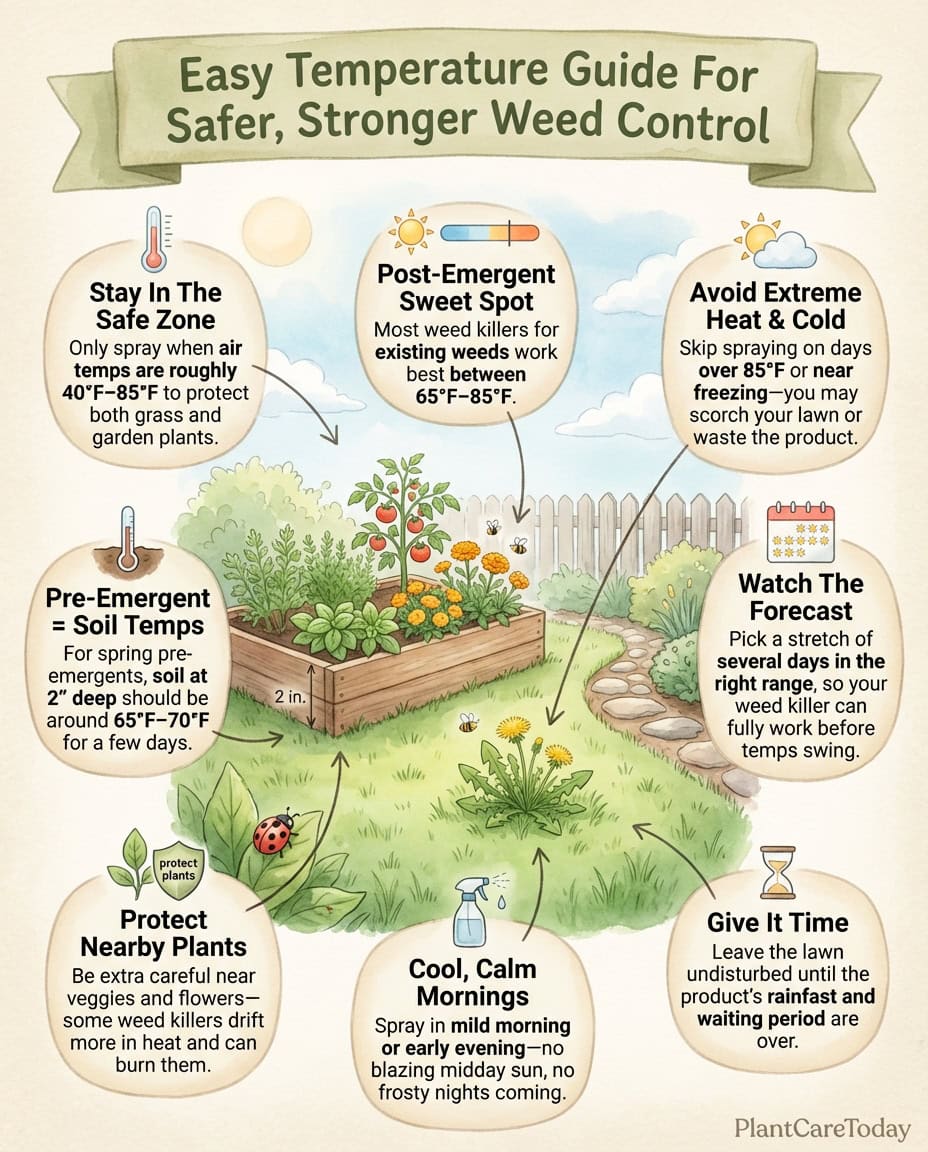
Temperature ranges for herbicides depend primarily on the herbicide type.
However, no herbicide should be used when the temperature is outside the range of 40° to 85°F.

Contact (AKA Burndown) Herbicides
Contact weed killers can be some of the most useful post-emergent herbicides, but only when used for spot treatments.
These weed killers work by direct contact, absorbing into the target plant and killing it to the roots.
Unfortunately, the method of application means contact herbicides ar probe to evaporation.
Contact herbicides can generally be applied at temperatures between 40° and 60° Fahrenheit, but may also be applied at up to 85° Fahrenheit on an overcast day.
Speaking of overcast, avoid using contact herbicides such as glyphosate-based herbicides when temperatures dip below 40°F for an extended period, or when there’s a combination of cloud cover and lower temperatures.
These cause weeds to become sluggish, which delays proper absorption and circulation of the herbicide down to the weed’s roots.
Post-Emergent Herbicides
Post-emergent herbicides are designed to tackle existing weeds.
As a result, rather than lingering like pre-emergent formulae, they tend to accomplish their job and vanish.
This means your average post-emergent formula requires a warmer temperature range to be most effective. Except for contact herbicides, post-emergent herbicides work best in a temperature range of 65° to 85°F.

When applied at lower temperatures, these weed killers may become less effective.
Meanwhile, applying a post-emergent herbicide to your lawn or garden when temperatures exceed 85°F can cause the herbicide to work too well, resulting in damage to crops or other desirable plants.
Some post-emergent weed killers who become especially volatile in excess heat include 2,4-D, dicamba, and MCPA.
Other post-emergent herbicides are affected in the opposite manner, especially ALS-, Sencor-, or fenoxaprop-based herbicides.
These products can harm crops at temperatures below 60°F, and freezing temperatures can render them ineffective at killing weeds while damaging your crops.
To help ensure maximum effectiveness against weeds and minimal risk to desirable broadleaf plants or crops, try to apply post-emergents on a day when the temperature is at least 60°F.
The daytime temperature should not drop below this level for several days to a week, although nighttime temperatures can be slightly lower.
Pre-Emergent Herbicides
Pre-emergent herbicides do the exact opposite of post-emergent formulas.
These weed killers attach to seeds as they germinate and remain active in the soil for up to 5 months. Because they’re soil-based, there’s less risk of evaporation.

Before applying a pre-emergent, stick a thermometer into the ground about 2 inches deep.
For summer weed protection, apply in the spring when the soil temperature is between 65° and 70°F at the time of application and for a few days afterward.
For the second application (to control fall and winter weeds), the ground should remain at around 55°F for at least 5 days.
Some Final Tips
When applying any weed killer, monitor the weather forecast.
Do not apply if the temperature is expected to fall outside the safe temperature range for the pesticide you plan to use.
You will also want to avoid overcast weather unless you’re applying a contact herbicide at temperatures at or above 80°F, as they’ll be at risk of evaporating too quickly in the sunlight.
Pay attention to the types of plants near your treatment area, especially broadleaf plants or grass-like food crops (maize, foxtail, wild oat, etc.), as certain herbicides can damage crops rather than weeds when temperatures fall outside a safe range.
Finally, don’t forget that herbicides require time to take effect, and you will need to stick in the proper temperature range until you’ve passed both the rainfast period and the minimum number of days for that product to take effect.