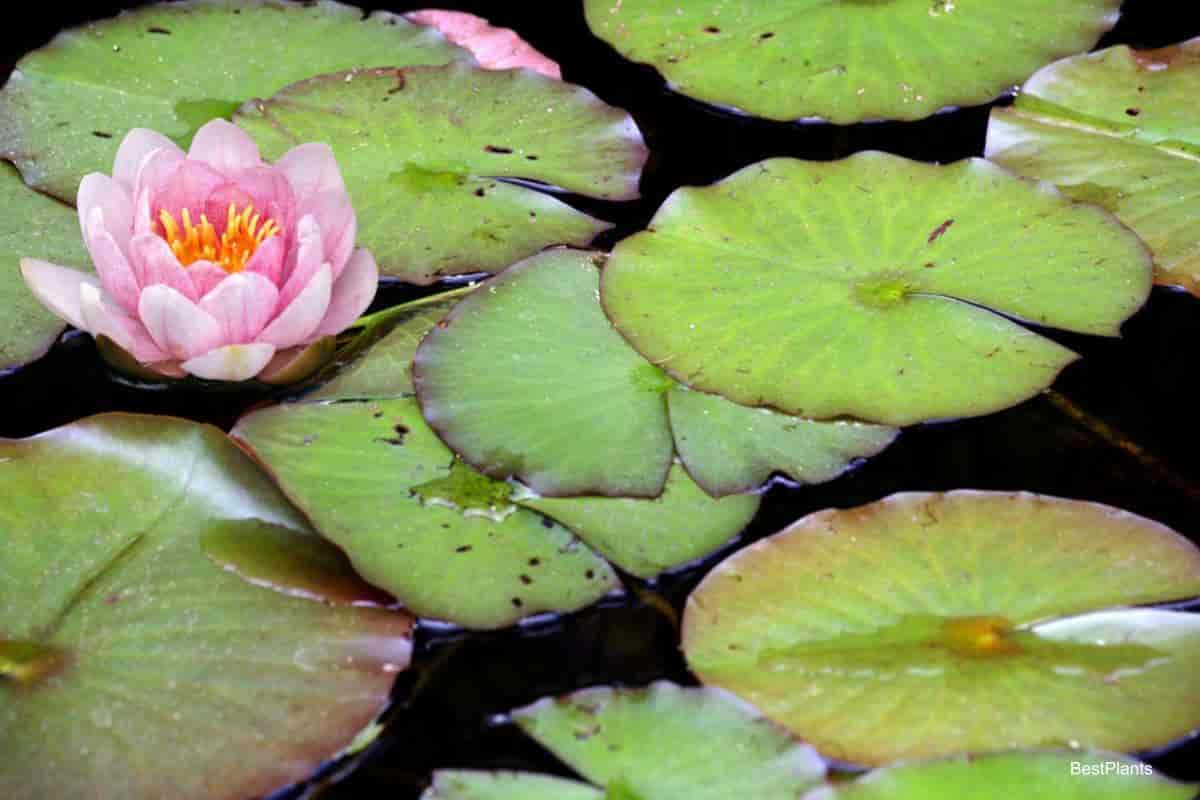
The cultivation of the graceful water lily dates back to antiquity. Long valued florally, both the tuber and seeds of the waterlily have also been used for food.
It was the favorite flower of one Chinese writer of the eleventh century, even though, since about 660 A. D., it had been fashionable to admire the showy peony. The pure white waterlily of China, Nymphaea tetragona, is the pygmy of the genus.
In ancient Egypt, the waterlily was linked with religion and death. Two species frequently figure on monuments and tombs: Nymphaea lotus, the night-blooming white lotus (the truly sacred lotus of the Nile), and Nymphaea caerulea, the blue day-blooming waterlily.
The funeral custom was to lay wreaths and semicircles of flowers on the breast of the wrapped corpse. Petals of both were found in the wreaths and decorations in the tomb of Rameses II, dated about 1850 B. C.
Waterlilies may be found in the lowlands of temperate, subtropical, and tropical countries. The groups classified as hardy waterlilies are those found throughout the Atlantic coastal plains of North America and Europe. The tender night-bloomers, the Egyptian Nymphaea lotus and the Indian Nymphaea Rubra, are said to be held sacred.
In India, they are often associated with Hindu temples. These are the two species from which all the present hybrid night-blooming varieties have originated. The zanzibarienses and stealth waterlilies are African tropical day-bloomers.
Australia has yielded the beautiful blue and recently introduced white tropical water lilies, rarely seen in Eastern gardens unless grown under glass.
Day and Night-Blooming Tropical Water Lilies
The aristocratic tropical lilies have been grown successfully at the St. Louis botanical garden. Since there are both day and night-blooming tropical lilies, their fragrant blossoms rise a foot or more above the water. It may also be enjoyed after the heat of the day. Floodlights have been installed above the pools for nightly displays.
The opening and closing of the flowers are governed by sunlight and temperature. During July and August, when the temperature is above 70° degrees Fahrenheit, both diurnal and nocturnal lilies open with precise regularity, the night-bloomers from 7 P. M. until 9 A. M. and the day-bloomers opening at 8 A. M. and closing at 6 P. M.
When the temperature drops below 70° degrees Fahrenheit, and the sunlight is absent; their habits are reversed. Often the day-bloomers will stay asleep throughout the day, and the night-bloomers will remain very much awake.
The first hybrid waterlily was developed in 1851 when Nymphaea rubra of India was crossed with Nymphaea lotus of Egypt by the gardener to the Duke of Devonshire in England. This variety is still grown in waterlily collections under the name Nymphaea devoniensis.
When it was introduced, it created so much of an impetus for waterlily culture that the Duke had unique greenhouses with heated tanks built to grow these nocturnal lilies.
In 1887 William Watson, the Kew Botanic Gardens curator in London developed N. kewensis. The hardy waterlilies were revolutionized by the work of the French hybridist Bory Latour-Marliac, between the years 1888 and 1890.
One of the earliest Itybridists in this country, William Tricker, is known for his work with the Panama Pacific variety.
My own breeding experience with waterlilies was begun in 1912. In experiments since then, the first white and first yellow originated, and white, yellow and pink were added to the viviparous types (types that produce different plants on the center of the old leaves). Currently, 30 varieties, both day- and night-blooming, are in the commercial field.
Preparing The Water Lily Pool
Full sun is essential for all waterlily cultures. The depth of the pool will depend upon whether the lilies are to be grown in boxes or on a natural soil bed. The -plants need about a foot of water above them for proper development and at least a foot of soil to grow.
If they are to be planted in boxes, each plant should be allowed a bushel of soil; if produced directly in pools, a foot of soil above any impervious bottom will suffice. Waterlily pools may become discolored, and weed control may be difficult if the base is entirely soil-covered.
For this- reason, many gardeners prefer to raise their lilies in large boxes or half-barrels, setting these containers on the pool floor. Ample spacing between plants should be allowed since lilies need a spread of 6’ feet to grow properly.
It is unnecessary to provide a continuous fresh water supply for a lily pool. The lilies do best in the water of a warm and even temperature. If the collection is stocked with fish and snails, the water will stay pure and clear, and the mosquito larvae will be kept down. Only enough freshwater needs to be added from time to time to replace that lost by evaporation.
Planting The Lines
If yeti has a large pool, make a planting plan drawn to scale. This will save considerable time in planting out and ensure color harmony. A bamboo marker stake will indicate the location of each lily. This will help show the position of a dormant tither, should it “go to sleep” unexpectedly. The stake may be removed after the plant is established.
It is better to put only one waterlily in each spot or container. Two lilies planted together will give an unbalanced effect through interference with natural radial growth. Unless 6’ feet of space is allowed for each plant, the new leaves will be crowded out of the water, flowers will be disfigured, and the perfect pattern created by leaves, water, flowers, and sky reflection will have been sacrificed.
Shipped waterlily plants should be unpacked immediately upon receipt and placed in water until they can be permanently planted. When you transfer young lilies to outside pools, cover them with a wet cloth to prevent leaves and roots From drying out.
The plants should be kept in their pots until ready to plant; otherwise, most of the moist soil will fall away from the roots when one wades through the water to the marker stakes.
Before planting, scoop out a hole equal to the size of the pot. Hold the inverted pot with your left hand and tap the pot’s base with your right palm. Then place the unbroken ball of soil and roots in the hole and firm the plant down, with the crown of the lily slightly above ground level.
Cover the Soil Surface
The soil surface should be covered with sand or gravel to prevent disturbance by fish, but the plant’s crown must remain uncovered.
Waterlily leaves sometimes remain submerged after planting, but they will extend their petioles and reach the surface the next day. Do not allow more titan a foot of water above the plant at planting time. Suppose the pool is so deep that a higher level is necessary.
In that case, water may be added gradually as the plants develop, but 18” inches is the most significant water depth permissible above the crown of the lily.
The time to plant lilies outdoors will depend upon the climate. Tropical waterlilies cannot stand a water temperature below 70° degrees Fahrenheit. A lower temperature makes the plants dormant, from which they are slow to recover.
In the Midwest, tropical water lilies can usually be planted by the middle of May, but in the East and the Great Lakes region, the first of June is more likely to provide the necessary 70° degrees Fahrenheit minimum, both day and night.
In addition to controlling the few pests which may attack waterlilies, all discolored leaves, faded flowers, and seed pods should be removed. If one is growing any lilies with the young plants sprouting from the parent leaves, the old leaves should not be cut until the tiny plants in the leaf sinuses (the space between the lobes) have developed.
Some of these viviparous lilies are strong enough to start young plants within the second whorl of leaves, but many are slow to form and appear only in the outer leaf circle.
To remove all floating leaves and debris from the pond, you can make a handy gadget by stretching a copper-screen wire across a frame 1 x 1 ⅛’ feet and attaching it to a 6’ foot handle. With this skimmer, you can keep the surface of the pool clear.
Pool Maintenance
Algae can make the pool unsightly before the waterlilies have grown enough leaf cover to shade it out. Don’t improvise a treatment by dragging loose chemical through the water — copper-based algaecides are only safe and legal to use as an EPA-registered aquatic product, applied strictly at the rate on its label, and even then extension specialists warn copper sulfate is one of the most commonly overused and misapplied chemicals in pond management.
For a pool stocked with fish, skip chemical algae control first: stock fish and snails to graze algae, let lily pads and floating plants shade part of the surface, and remove decaying leaves and excess fish waste that feed algae blooms. If algae becomes a serious problem, use only a product labeled specifically for ponds with fish, and follow its label directions exactly.
Crawfish In Pools
The crawfish, often a pest in natural pools, may cause leaks in the banks, or they may pinch off young leaves before they reach the water surface. Trap them instead of poisoning them: a baited minnow trap, or a piece of raw meat weighted just under the surface near the bank, will draw crawfish in within a few hours so you can remove and relocate them.
Reducing hiding spots along the bank and keeping the pool stocked with fish also helps keep crawfish numbers down without putting any chemical in the water.
Waterlilies and Insect Pests
Relatively few insects attack waterlilies. Giant insects may be picked off by hand. Aphids may be removed from the lilies by a forceful water spray and will furnish live food for the fish.
Aphids on waterlilies are easy to deal with without any chemical: hose them off the leaves with a strong spray of water and let fish eat them as they fall, or introduce ladybugs nearby, which prey heavily on aphids. If no fish are present, an insecticidal soap labeled safe for pond/aquatic use, applied per its label, is the appropriate modern option — not nicotine sulfate, whose last EPA registration was cancelled in 2014.
The leaf miner, Chironomos modestus, sometimes tunnels its way under the epidermis of the leaves, causing irregular yellow lines. Where the growth of plants is rapid, this insect may be controlled by cutting off the affected leaves and burning them.
If leaf miner damage shows up, simply cut off and destroy the affected leaves — that alone controls this pest, since the delta moth larvae responsible do only cosmetic damage and the plant’s own rapid new growth outpaces them. No pesticide is needed here; lead arsenate, which older guides sometimes mention for this purpose, had every insecticidal registration cancelled by EPA in 1988 and is illegal to use today.
The delta moth, Hydrocampa proprialis, is active in St. Louis from July on. However, this pest causes no significant damage, as the rapidly growing lilies need the weekly removal of leaves at this time. The delta moth’s eggs are laid on the underside of the young leaf.
The larva cuts two triangular pieces varying from ½” to 1” inch from the leaf edges and fastens itself between them by a web. It is completely hidden; it travels in its triangular raft over the water surface to other plants.
Since the propagation of tropical water-lilies demands full sunlight and heated water over the winter, most amateurs prefer to buy fresh plants each spring. It is possible to raise tropical lilies in an aquarium if electrical coils or similar devices provide constant heat.
Propagating Waterlilies
Propagation by tubers is the method most likely to be successful unless viviparous plants are available. The seed of hybrid lilies does not usually come true to type and may produce a worthless flower. Propagation of waterlilies from source is not recommended for the amateur.
After the first frost, waterlily plants should be dug up and washed. The large evident tuber has produced the current growth and is almost impossible to store satisfactorily over winter. A tiny propagating tuber about the size of a walnut will also be found at the base of most large tubers.
Night-bloomers and hybrids of Nymphaea colorata origin bear baby tubers at the top of the old bulb and the bottom. These small tubers should be removed and stored in slightly moist sand, in closed containers, until early spring. Then they are potted about 2” inches deep in sandy soil. Such deep planting is essential. since it induces a long growth away from the tuber itself.
In a sunny window, the pots should be placed in water of 70° degrees Fahrenheit or warmer. The young leaves ordinarily appear in about two weeks. As soon as the floating leaves have developed, locate the stemlike growth connecting the young plant to the tuber with your thumb and forefinger.
Follow this stoloniferous growth down to the tuber and carefully pinch it off just above the tuber, removing the young plant with its attached roots, but leaving the propagating tuber in the pot.
Repot Young Plants Immediately
The young plant should be immediately potted up to prevent its drying out and placed in the same heated tank where the propagating stock is growing. The original propagating tuber will send up another plant in two weeks, which can also be removed and potted.
This process may be repeated three or four times before the tuber is allowed to retain the last plant. The tank will then be filled with infant waterlilies capable of producing flowers of the same quality and variety as the original plant.
As young plants of the viviparous tropical waterlilies form in the leaf sinus during the growing season, they should be removed from the leaves for potting as their roots develop.
The multiple-headed plants raised from viviparous leaves will have smaller flowers than the single-headed forms grown from tubers. Not much can be done to reduce a multiple-headed plant once set out in a pool.
However, practically all viviparous lilies can be divided readily into single plants while still in the formative period. The young lily must be removed from the pot when the individual growths are discernible, with a central shoot to each one.
44659 by George H. Pring